|
Karnak-Temple |
last update:
14.11.2013
|
| |
Chambers of Hatshepsut (Palace of Ma'at)
|
|
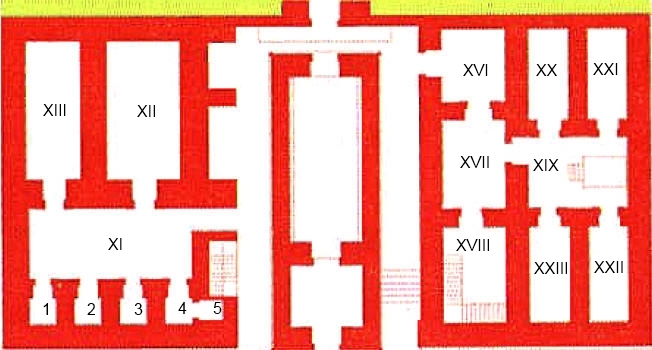
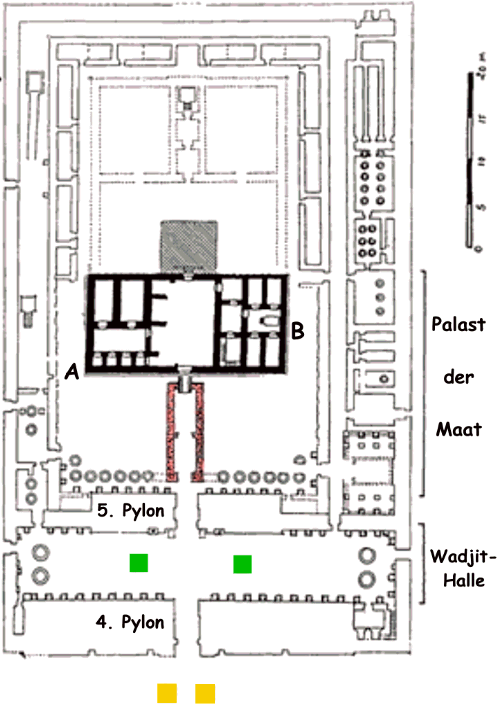
The above map shows the arrangement of the Chambers of
Hatshepsut around the Red Chapel. According to Porter & Moss II, Theban Temples,
the rooms are with Latin numbers; the rooms numbered 1-5 on the north side are
not numbered in Porter & Moss. The walls painted in yellow mark the boundary wall of the Middle Kingdom Court.
The floor plan is a modified excerpt from Burgos, Larché, La
Chapelle Rouge, 2008, p. 337, extension phase (C) under Hatshepsut. |
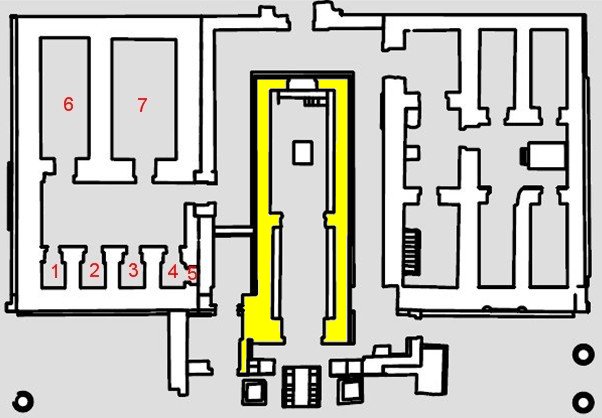
| For comparison the following figure shows the actual situation of the complex of rooms around the sanctuary built by Philipp Arrhidaeus
(Yellow), 323 - 317 BC.
|
| Palace of Maat (Name and Location) |
In the more recent literature, such as Barguet (Le Temple d ' Amon-re
of à Karnak, 1962), Blyth (Karnak - evolution of a temple, 2006) or in the
volume of the Dossiers d ' Archéologie, which is exclusively dedicated to Hatshepsut (Les
dossiers d ' Archéologie, no. 187, 1993), the center of the Temple of Karnak
which had been built during beginning of the New Kingdom is often called "Palace
of Maat".
Usually these publications do not give any information about the
(ancient Egyptian) origin of the name nor any information to which area of the
Temple of Karnak the name is applied - or the details prove wrong. |
| Finally, the Urk IV, p. 94, 6, pointed to a contemporary source
and the ancient writing of the name - on the north side of the obelisk of
Thutmose I, where it reads:
|
| Horus, "beloved by Re, who appeared in the White Crown", the
nbtj "who praises Atum, shiny in appearance", the King of Upper and Lower
Egypt, Lord of the two Lands "Aa-xpr-kA-Ra"- has
created by Re", the Golden Horus "great in strength, rich in power, fresh in
years in the Grand Palace of the goddess of truth": the son of Re, "Thutmose who
appeared as Re", the God, the ruler of Heliopolis", beloved by Amun-Re, the Lord
of the Thrones of the Two Lands, endowed with life like Re forever. |
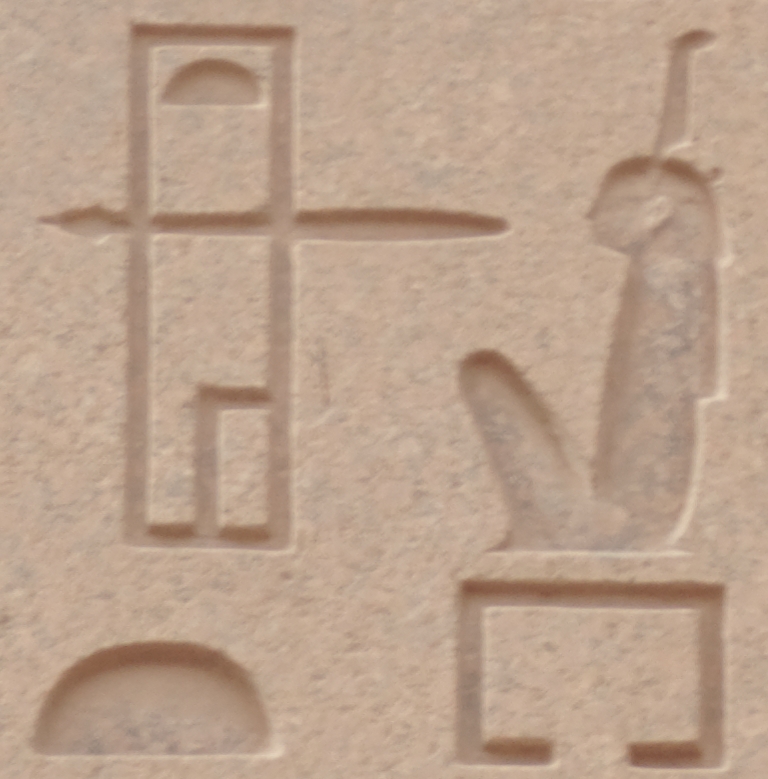
| Hieroglyphic writing of "Palace of Maat = @wt-aAt
MAat" on the obelisk of Thutmosis I.
|
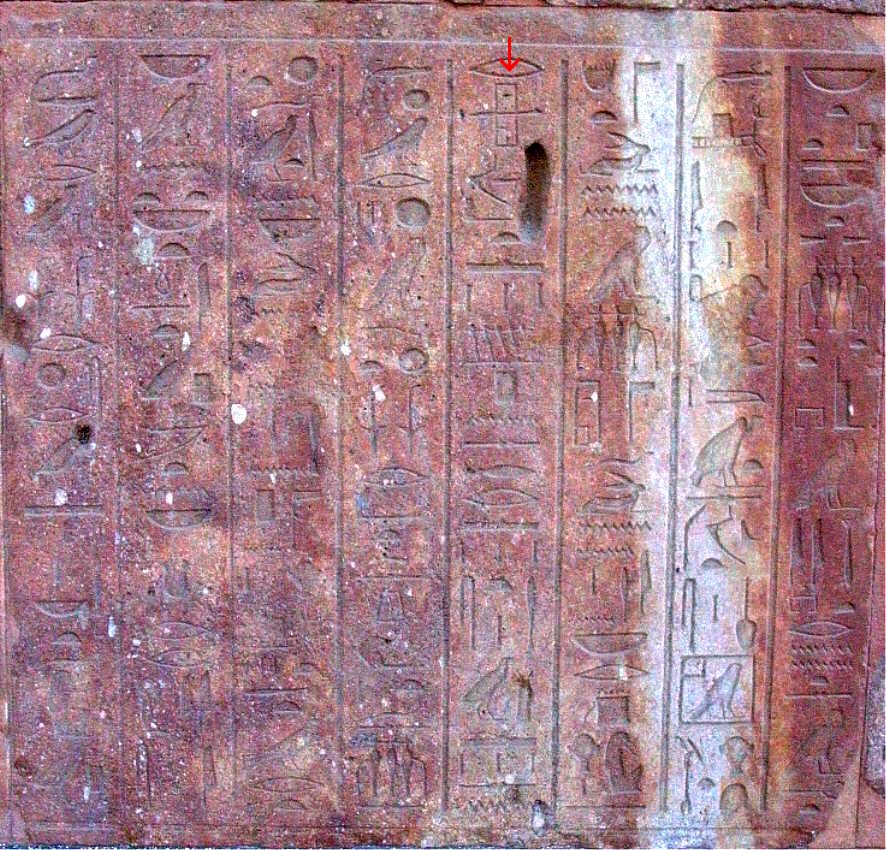
Also from the times of Hatshepsut there is a reference at a
block of the Red Chapel, no. 184, column 5 (see red arrow). Block 184 is located
on the southern outer wall of the chapel in register 1. The block belongs to the
so called "Oracle of Amun" and describes a part of the coronation of Hatshepsut:
"...Then he (Amun) placed her before him and caused her to go to the "Hall of
Justice ..."".
In contrast to the writing on the obelisk of Thutmose I here the name of the
goddess mAat is just written in single signs. |
| The name is mentioned for third time in the offerings list of
Thutmose III that builds the outside of the Northern Chambers of Hatshepsut
north of the sanctuary built by Philipp Arrhidaeus. |
| None of the contemporary sources for the term "Palace of Maat"
allows a secure identification what building or which part in the Temple of
Karnak was attributed to this palace. Modern authors use this term for the rooms
located North and South of the central bark sanctuary of Philipp Arrhidaeus
called "Chambers of Hatshepsut" and the Red Chapel of Hatshepsut (or the
replacement building Thutmose III). Depending on where the authors locate the
original place of the Red Chapel - between the northern and southern Chambers of
Hatshepsut or in the yard before - the term "Palace of Maat" contains only the
Chambers of Hatshepsut (including Red Chapel) or these chambers plus a courtyard
area in front of them. |
| Thus, El Hegazy and Martinez, the authors of the chapter about
the "Palace of Maat" in the Dossiers, chose the area for the palace so that it
included the rooms North and South of the sanctuary of Philip III. Arrhidaeus,
the Red Chapel (which was in 1993 located in front of this building complex; see
the following figure from the dossiers, P. 55) and the courtyard around the Red
Chapel. |
According to the research of the CFEETK, the Red Chapel is now
placed between the northern and southern rooms building complex (see Burgos,
Larché, plan S. 337, extension phase (C) under Hatshepsut).
Despite the research results of the CFEETK some authors do not accept this
placement of the chapel, so e.g. Warburton, who still assumes a placement of the
Red Chapel in front of the two building complexes - like el-Hegazy and Martinez
did. |
| Sullivan (Sullivan, A., Karnak: development of the Temple of
Amun-Re.) UCLA EE 2010) wrote - referring to Gabolde - that Hatshepsut at Karnak
- added a line of rooms before the front of the Temple of Senwosret: "...
appended a suite of rooms, her "Palace of Maat". She did not assign the Red
Chapel explicitly to the Palace. |
| However, on this web site it is assumed that the "Palace of
Maat" included the rooms North and South of the sanctuary and the Red Chapel,
although the Red chapel is presented on its own page. |
| Platform (Podium of Hatshepsut) |
|
Directly in front of the remains of the building from the Middle Kingdom
Hatshepsut had built her "Palace of Maat" made of sandstone, on a platform of
about 19 x 37 m. An inscription of Hatshepsut on the outside wall of the
Northern (left) rooms indicating that these rooms were built or finished in year
17 of Hatshepsut/Thutmose III (see the following figure).
|
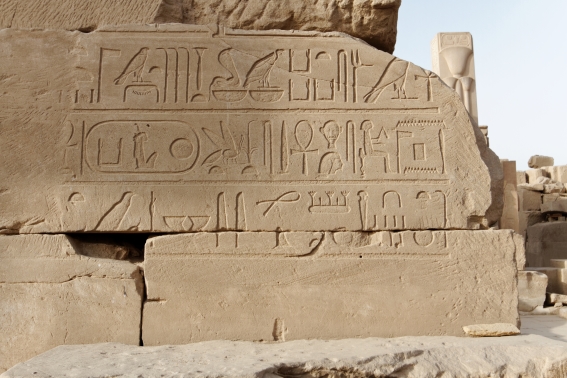
| Remains of inscription of Maat-ka-Ra (see cartouche in the 2nd
register,
left) containing the date of the erection of the rooms (Position A in the
floorplan of el-Hegazy and Martinez above; Year 17, lower row, see the horseshoe
with the 7 strokes below - the 3rd stroke in the lower row is partly damaged). |
| The excavations of the CFEETK revealed that the Palace the Maat
(and the Red Chapel) was built on an own podium. The podium was erected by three
layers of large sandstone blocks of which the upper two layers alone are about
80 cm high. Overall, the surface of the podium significantly higher than
the soil of the surrounding temple area and is only accessible through several
stairs - as clearly visible on its eastern side. |
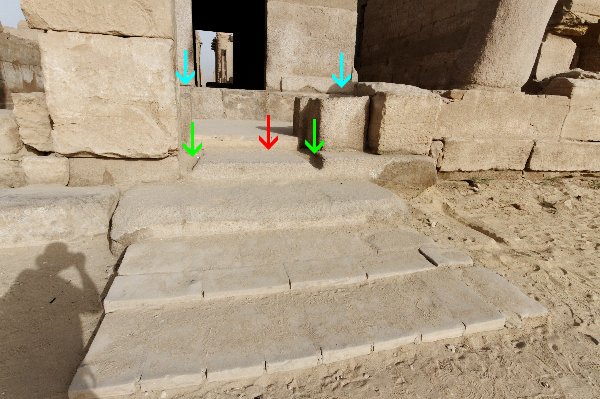
Gate leading from the "Palast of Maat" to the Middle
Kingdom-court - with some remains from the times of Hatshepsut:
- a granite threshold (red arrow) with two slides (green) used for the door
wings
- two granite doorjambs (blue).The photo clearly shows the difference between
the podium of Hatshepsut and the Middle Kingdom court. |
| The following drawing from the tomb of Neferhotep, TT49, shows
- viewed from the South - a part of the Temple of Amun during the times of Tutankhamun
to Eje. On the left the Nile River with sailing boats is shown, then to the
right of it a t-shaped harbor. The presentation continues -
from left to right - with the 3rd pylon with flagpoles (left), an obelisk (probably
the one of Thutmose I), then the 4th pylon with flagpoles and a portal on its West
side (erected by Thutmosis IV), and another (probably the today's) 6th pylon without
flagpoles. Right of this pylon there is a building with a cavetto cornice
depicted which was obviously erected on a podium. It looks like as if the podium
was also crowned by a cavetto - however, Larché confirmed on request that according to the results of his excavations no
cavetto crowned the podium - so the scene from TT49 is an idealized
representation. |
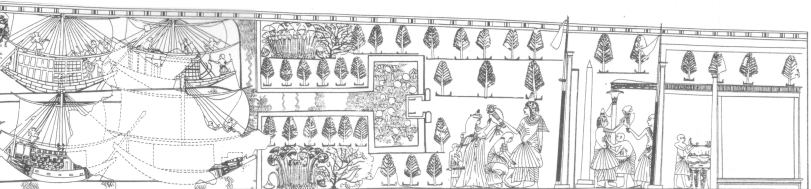
| Neferhotep visiting the temple of Amun at Karnak as depicted
in his tomb TT49 (taken from: Davies 1973, plate III).
|
|
The northern rooms and the texts in it are already well published and accessible
for tourists. Because of the size of the description the chambers are presented
on a separate page. |
| The southern rooms are not accessible to visitors because of
the narrow space. The rooms were published by Barguet, Le Temple D ' Amon-Rê à
Karnak, parts of the inscriptions were already published by Sethe,
Urkunden IV. Photos are available at the "Marburg Photo Archive", the "Chicago
Oriental Institute Photo", and in Schwaller de Lubicz (e.g. plate 165), etc.
Because of the size of the description the chambers are presented on a separate
page. |
|