|
Karnak-Temple |
last update:
19.04.2013
|
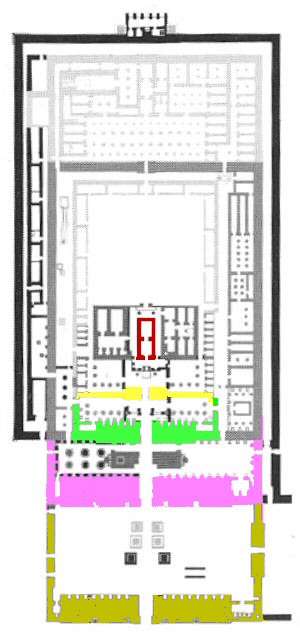
Floor plan of Ip.t-Sw.t ("Elected Place",
modern-day Karnak; plan according to Larché, 2007) at
the times of Hatshepsut and Thutmosis III;
in Red the "Red
Chapel", shown here at the actual discussed location between the
"Chambers" of Hatshepsut;
in Yellow the 6th Pylon, in Green the 5th Pylon, and in Pink the 4th Pylon;
in Brown the "Great Festival Court" of Thutmosis II. |
| The center of the temple of Amun-Ra at Karnak extends from 4.
Pylon eastwards to the "Festival Hall" (Akh-menu) of Thutmosis
III (in the
floor plan above the Akh menu follows directly in the east - i.e. above - the central district). For today's visitors this
area of the temple is very confusing, since wide areas are destroyed and beyond the
hypostyle of Sethi I or Ramses II one practically walks through
ruins. Beyond that the temple was totally altered several times during the 18. Dynasty.
An actual summary about the development of the temple of Amun-Ra is presented by
Sullivan (2010).
|
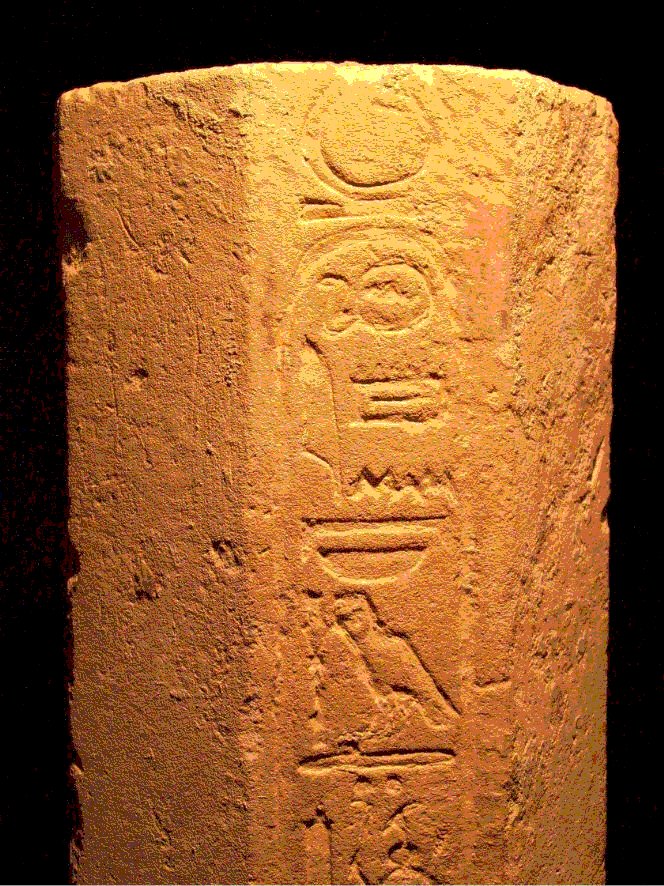
| The first inconvertible evidence for a temple of
Amun-Ra at Karnak is found on a column from the reign of Intef II in the First
Intermediate Period. The 8-sided column made of sandstone was found reused at
Karnak and shows an dedication text of that king who erected a temple for "Amun-Ra, Lord of Heaven" (photo right, upper part of the column with the name Amun-Ra - Ra in front
and decorated with an uraeus; photo: author). According to Gabolde (Gabolde, L.,
Le Grand Chateau d'Amon de Sesostris 1er à Karnak. Paris 1998, p. 112) the column was
found reused in the floor "du texte de la jeunesse" of Thutmosis III. Finds
indicating an older temple could not be undoubtedly confirmed - unless new doubtless
evidence is discovered- it must be assumed that a temple of Amun-Ra did not
exist at Karnak prior to the First Intermediate Period. |
|
 |
|
Senwosret I (= Sesostris I, 2nd king of the 12. Dynasty) in the Middle Kingdom (MK) was the first king who had
built an important temple at Karnak. The large granite thresholds - of rose granite - of the central
floor which are still to be seen today (see the following photo) between the barqueshrine and the "Festival Hall" were
probably part of the temple raised by Senwosret I. |
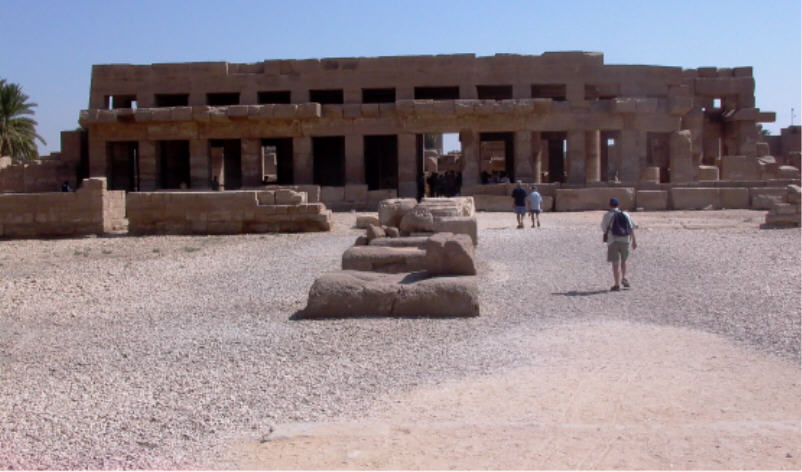
| View from the barqueshrine of Philippos Arrhidaios (see
below) to the "Festival Hall" of Thutmosis III. Here on the central west-east axis of the temple granite thresholds of the old temple from the MK
are still to be seen as well as the basis of the throne of Amun made of
limestone.
|
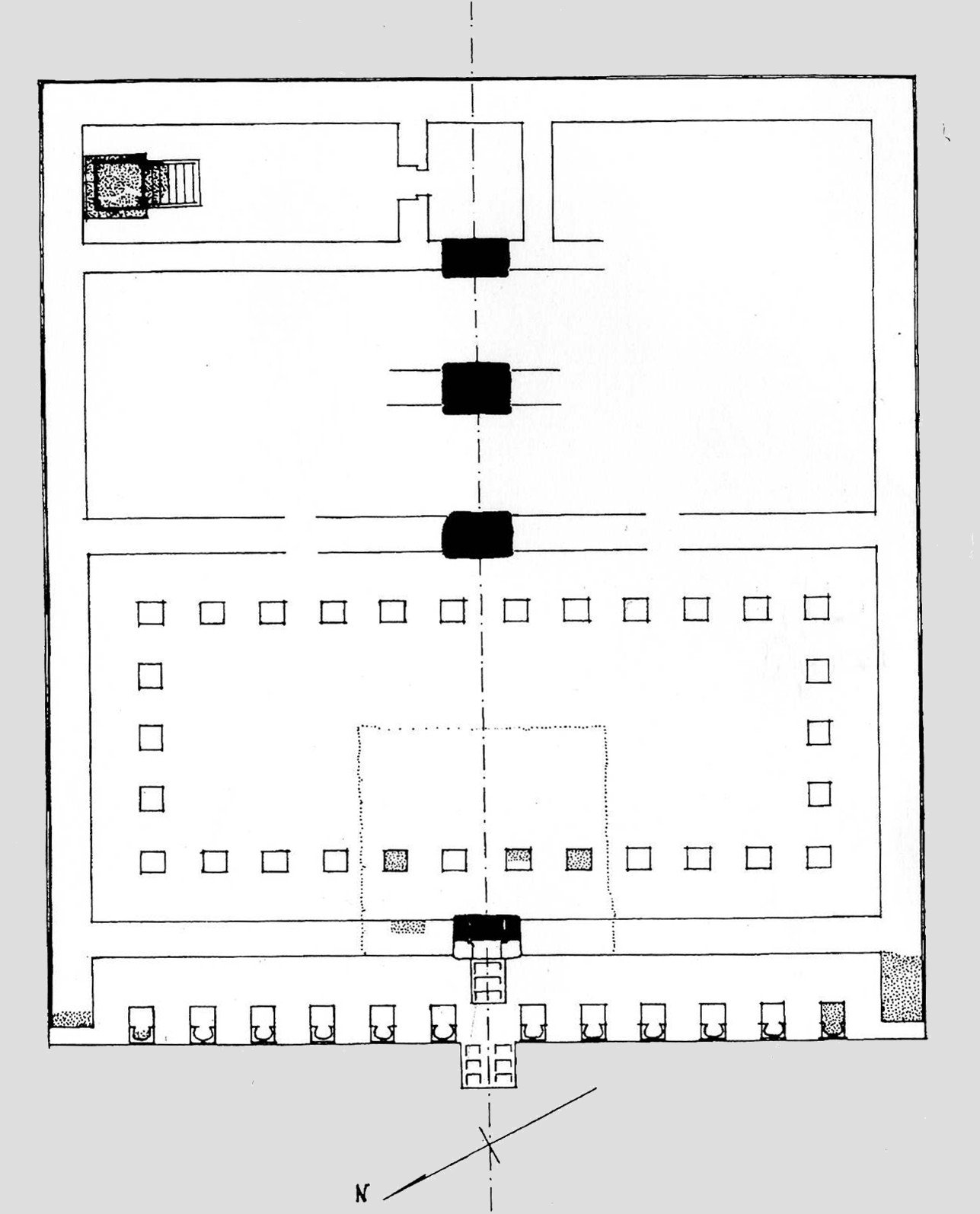
| Plan of the temple of Senwosret I. (taken from: Gabolde, Carlotti,
Czerny, 1999); the black blocks represent the remains of the granite thresholds,
the dashed square mark the location of the elder platform excavated in the
ground of the Middle Kingdom court. In the left upper corner the reconstructed
position of the throne of Amun is shown.
|
| The temple of Senwosret I. impressed (on its western side) with a
portico with 8 pillars on each side wing (see below; drawing taken from: Gabolde, Carlotti, Czerny, 1999).
In front of each pillar stood an Osiride figure of Senwosrets |
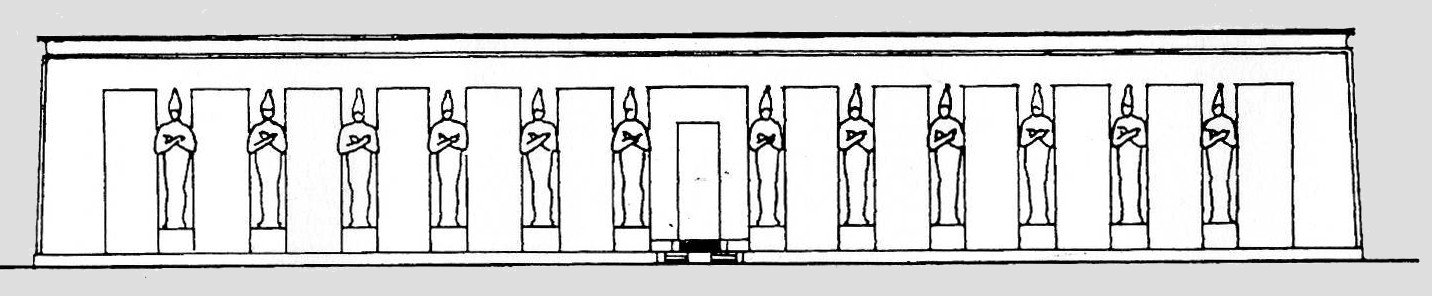
| This portico had been dismantled at latest during the reign of Hatshepsut
when she built the "Chambers" and the Red Chapel - both are called "Palace of Maat". However, the impressive facade was
"resurrected" in her Mortuary Temple at Deir el-Bahari -
where the number of pillars on each side wings had been doubled and the number
of Osiride figures was increased to 13. |
| The position of the throne of Amun (as shown above in the plan
of the temple of Senwosret I) is more or less a guess and based on the
assumption that Thutmosis III copied the old temple when he built his
festival temple (Akh menu) - and there the throne is located in a room in the
north-east corner of the Akh menu. |
| Senwosret I built his temple over the remains of an elder
temple of Amun which is to be dated into the early Middle Kingdom as testified
by the remains a great platform excavated in the ground of the Middle Kingdom
court. |
| The remains of the platform, which was approx. 10 m long and 8
m wide, consisted of at least two stone layers and was built on the western part
of the Middle Kingdom court i.e. between the Chambers of Hatshepsut and
the granite thresholds of Senwosret I. The platform is tentatively dated into
the time of Amenemhat I. Gabolde, Carlotti, and Czerny (1999) assumed that this
platform functioned as the foundation of a small temple comparable to the
Small Temple of Amun at Medinet
Habu which was erected on platform of comparable size. |
| When this platform was built sand- and limestone blocks of an
elder building had been re-used which is most likely to be dated into the
beginning of the Middle Kingdom (see also -> Mentuhotep Nebhepetre ->
Karnak (only
in German). |
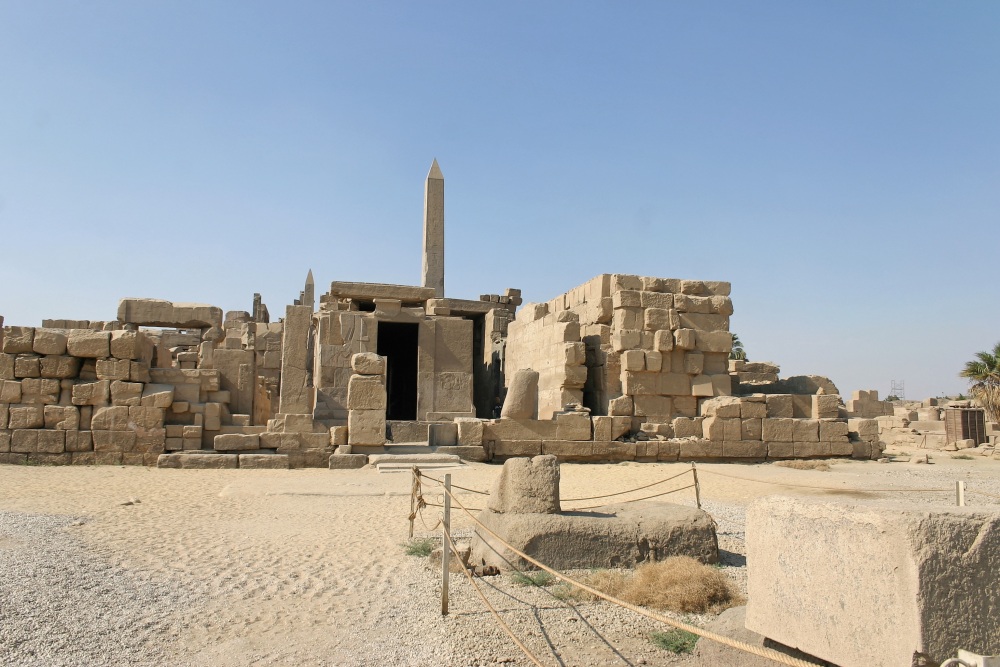
| View of the western part of the Middle Kingdom court showing
the central sanctuary and the rooms of Hatshepsut. In front of the entrance to
the sanctuary the remains of the Middle Kingdom platform are visible. |
|
After the kings of the MK the 17. Dynasty from Thebes felt in special way
obliged to Amun who after long fights led them to the victory over the Hyksos, and to the reunification of the
kingdom. Logically they and the rulers of the following dynasties derived the
legitimation of their rule from Amun. Therefore, they extended the
modest temple of Amun erected in the middle kingdom to an impressive
monument. Thereby, the oldest and holiest area from the temple of the middle
kingdom was integrated into the new building without changes.
|
| Amenhotep I extended the temple. In the stone magazines of Karnak
there are over 800 decorated blocks and 500 block fragments made of limestone which come from the
temple buildings of Amenhotep I. The blocks and fragments were already cleared away in
antiquity by his successors and were reused as filler, so e.g. in 7. Pylon and in the foundations of the Akh-menu
erected by Thutmosis III, in the 3. Pylon and in the buildings raised in
the northern area of Karnak by Amenhotep III (Graindorge, 1999). It is
only due to the re-use that these blocks had not been destroyed in later time
by limestone robbers.
|
|
The reconstruction on the basis of these blocks showed in a large-scaled temple which was
erected in the front of the sanctuary of the MK (the following floor plan
shows the temple after the 2nd extension phase; according to Carlotti
taken from Graindorge, 1999). Beyond that it was shown
that Amenhotep I obviously had dismantled and replaced own buildings by newer ones.
|
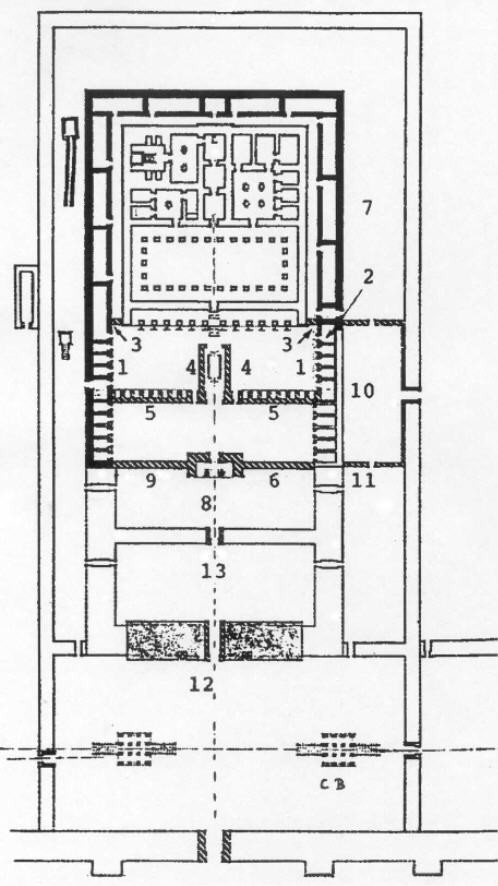
| Plan of the temple of Amun-Ra after the modifications during reign of Amenhotep I (taken from: Carlotti, 1998). |
|
In the 1st phase Amenhotep I. extended the building of the MK by a wooden
barque shrine with two enclosure walls (No. 4 n the plan above), at the southern side of the
court 11 chapels were built (right of Pos. 4 numbered as position 1).
|
The 2nd extension phase was much more ambitious. The 11 chapels on the southern side of the
court were rebuilt and supplemented by comparable chapels (position 1)
built on the opposite side of the court. The enclosure walls (4) around the
barqueshrine were rebuilt converted and connected by two walls with 8 niches each
(5) with the sides of the court. The niches were probably aligned to the east and contained
statues of the king. The brick wall around the temple part of the MK was replaced by a limestone wall (7).
Behind the southern chapels a slaughterhouse
was erected as an open court (10).
To the west an approx. 7 meters high wall with a central gate
has been erected (6, 8, 9), later the 6. Pylon was built here. Furthermore, all
brick walls originating from the MK were taken down in this area of the
temple and another, more than 10 m high gate (12) was built were later the 4. Pylons
has been erected. Still further west Amenhotep I let built an accurate copy of the
"White Chapel" (CB=
Chapelle Blanche) of Senwosret I (Sesostris I) just opposite to the
"White Chapel" itself. In the corner south-west of CB Amenhotep
I erected another the so-called Alabaster-Chapel (re-erected in the
Open-Air-Museum, Karnak).
|
|
The buildings of Amenhotep I. did not survive for a long time. The fact
that blocks had been already used as filler in during the reign of Thutmosis
III and later of Amenhotep III. means that they probably had been
dismantled already in the times of Thutmosis I. to Hatschepsut.
|
| The building effort of Thutmosis I, successor of Amenhotep I,
at the temple of Karnak had a great effect on the activities of his successors. |
| At the western side of the temple Thutmose I erected a monumental gate, the 4th pylon, and at the
same time a little bit further to the East a smaller gate, the 5th pylon. Both
pylons were connected on their northern and their southern side by walls forming
an open court. |
| The development of this court during the time of Thutmosis I
to Hatshepsut is presented on a separate page -> Wadjit-hall. |
| Further west Thutmosis I erected in front of the 4. Pylon the first pair of
obelisks which were donated for the temple of the Amun in Karnak.
Today, one of these two obelisks is still standing at his original place.
The architect Ineni, responsible for the work on both, reports in his
tomb (TT81) about the erection of the obelisks. At least 17
obelisks helped to define the sacred landscape of Karnak (in pair
erected were: 2 of Thutmosis I in front of pylon 4, 2 of Thutmosis
II/Hatshepsut in front of pylon 4, 2 of Hatshepsut between pylon 4 and 5
and another pair in the east of Karnak behind the "Festival
Hall" (Akh-menu) of Thutmosis IV, a pair of Thutmosis III in front
of pylon 4 - between the pairs of Thutmosis I and II - and a 2nd pair in
front of pylon 7, 1 of Thutmosis IV, 2 of Amenhotep III - in the district of Month at
Karnak -, and 2 of Ramses II in the temple "Amun, hearing
ears" in the east of Karnak). In addition, a single Obelisk - the
Lateran-obelisks, built under Thutmosis III, erected by Thutmosis IV - was
venerated in the temple of Amun-Ra-Horakhty (Bell, 1999, Habachi, 2000).
|
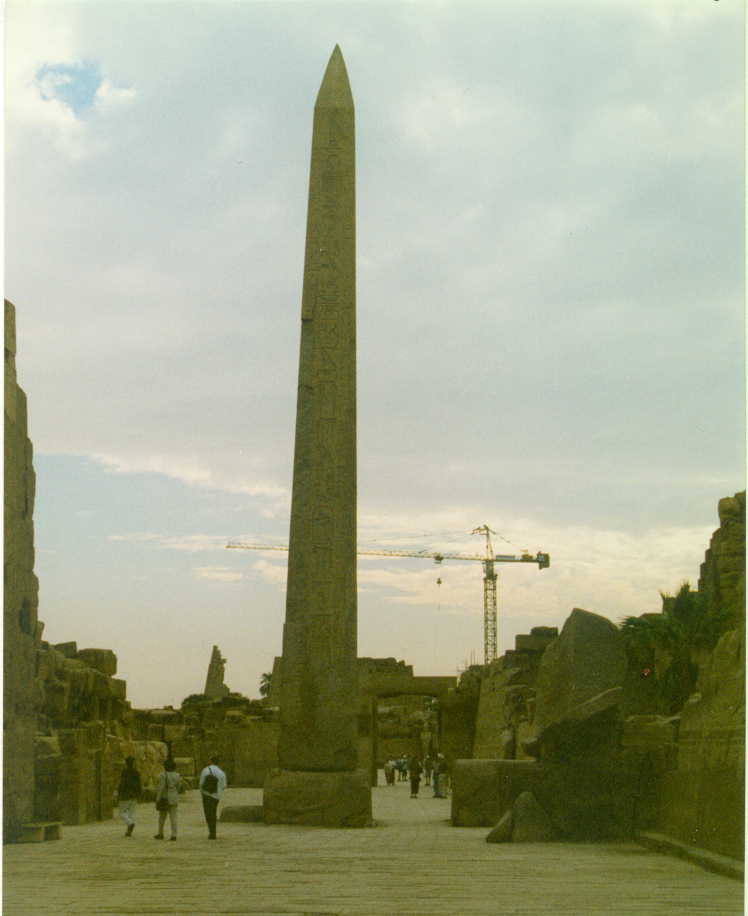
| Obelisk (Height: 20 m; Weight: 143 t) of Thutmosis
I before that 4. Pylon at Karnak temple with modern construction crane. |
| A few tracks in the Centre of the Temple of Amun of Karnak are
found from the reign of Thutmose II. West of the 4th pylon he had obviously an
another pylon, so that was a big "Festival Court" which surrounded the Obelisk
of his father's. On the South side, the "Festival Court" had a gate in the form
of a small pylon. This pylon and later constructions of Tuthmosis IV were torn
down by Amenhotep III to make room for the present-day 3rd pylon. Gabolde (1993)
found remains of the constructions used as filling material in the 3rd pylon. |
| Thutmose II had ordered two obelisks made of red granite which
should be placed in his "Festival Court" in front of the obelisks of his father.
The two bases were found below the 3rd pylon. Probably, the king died before
they were raised. Preserved parts of this obelisks with inscriptions show that
they originally belonged to him but of Hatshepsut added own inscriptions and
dedicated them to her father. |
| During the numerous excavations at Karnak a lot of fragments
came to light from the time of Thutmose II, Hatshepsut and Thutmose III. Several
limestone blocks were found during the excavation of the Cachette in the
courtyard in front of the 7th pylon, where they had been used in the foundation.
Gabolde (2005) has examined the numerous blocks and deduced the existence of
four buildings made of limestone - the
"NTrj
mnw = Divine Monument", a small "chapel with niches" which was devoted
to the cult of several members of the royal family, a "(Barque-)Chapel/Sanctuary", and finally, a small
chapel from which only fragments survived. The analysis of blocks decorated with flat raised reliefs revealed that these buildings
belong into
the period of the conversion of the "Great Royal wife; God's wife of Amun" Hatshepsut as
regent for Thutmose III and finally to the "Lady of the Two Lands Maat-ka-Ra" - a period that is so far rather poorly
documented in the monuments. |
| These buildings of which the
"NTrj
mnw = Divine Monument" is currently reconstructed by the
CFEETK at
the entrance of the Open Air-Museum at Karnak-temple are presented on a separate
page. |
| From the whole temple section of the middle kingdom,
between the sanctuary and the enclosure wall in the east, practically nothing
had survived. Most likely, the buildings raised by Amenhotep I and his predecessors were
already ramshackle at times of Thutmosis III but probably could not be pulled down for religious reasons. Thus, Thutmosis III
raised new buildings directly in the east of the old temple area.
|
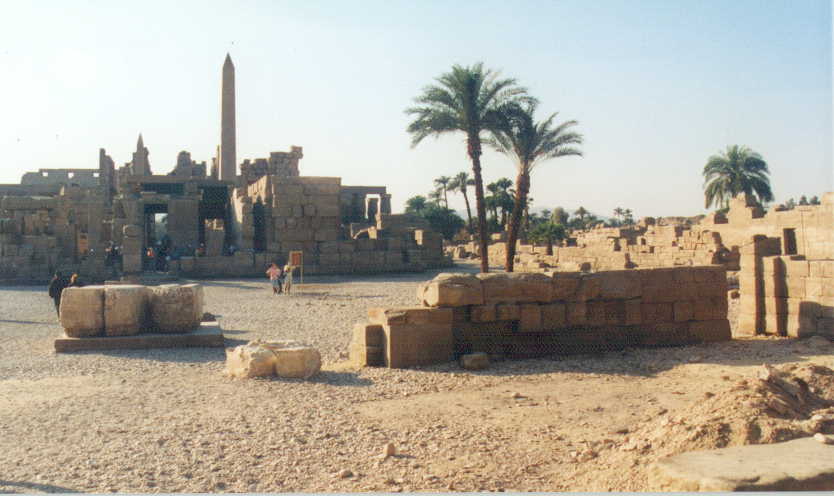
| Today's view from the "Festival Hall" (Akh-menu) of Thutmosis
III to the rear side of the sanctuary of Philippos Arrhidaios and the
"Chambers of Hatshepsut"; on the right behind the sanctuary the obelisk of
Hatshepsut is to be seen, that of Thutmosis I is to be seen on the left
but only the top is to be detected; on the free space between the
"Festival Hall" and the sanctuary the first temple from the
MK and that of Amenhotep I had been built with limestone.
|
| The ramshackle buildings between the "Chambers of Hatshepsut" (in
which Thutmosis III installed a new sanctuary after he had
dismantled the Red Chapel built before them), and
the new rooms in the east of the temple (Akh-menu, etc..) erected by Thutmosis
III were cleared away in late roman time by limestone robbers - therefore is there today a relatively
empty space (see picture above).
|
After her father Hatshepsut rearranged the temple district enormously. With security
the following extension of buildings or their replacement which took place in the reign of
Hatshepsut can be identified (all represented on an own page):
- the Red Chapel - was
erected as a new central sanctuary in front of the Chambers of
Hatshepsut
- |
| - Chambers of Hatshepsut - a complex of
rooms right and left of the Red Chapel which replaced the older central part
of the temple, i.e. the sanctuary and niches erected by Amenhotep I
|
| - Wadjit-hall - Hatshepsut changed the
hall erected by her father's and erected her 2nd pair of obelisks in the center
of the hall |
| - two pairs of obelisks, one pair east of
the central buildings of the temple, the 2nd pair in the Hall of Wadjit between the 4. and 5.
pylon
|
| - 4 small monuments to be
dated in the time of upheaval - from the reign of Thutmosis II into the
first years of the reign of his son, Thutmosis III, with Hatshepsut
acting as Queen Regent
|
| According to El-Sayed Hegazy and Martinez (1993) the name
"Palace (Great House) of Ma'at" for the complex of the Red Chapel and magazine
chambers goes back to an architrave of Thutmose I (however, the report gives no
localization nor a detailed description of the architrave). This may be
connected with the fact that Thutmosis I placed a reference to the "Great House
of Ma'at" in one of his gold names: "aA-pHtj wsr-xpS
wAD-rnpwt-m-hwt-aAt-MAat = with great force and abundant power, with
prosperous years in the Great House of Ma'at" (Beckenrath, 1999, p. 134;)
Schneider, 2002, p. 289). |
| The last large structural modification of the central temple took place under Thutmosis
III. Between the 5. Pylon and the "Chamber of Hatshepsut" a further small
gate was added - the 6. Pylon. The Red Chapel of Hatshepsut was
dismantled, since it stood in the way when Thutmosis III raised his own
buildings. Thutmosis III replaced the Red Chapel by a new
sanctuary, (later in Greek
times, the sanctuary of Thutmosis III was replaced by another one
built between 323 - 317 B.C. by Philippos Arrhidaios). To build the new
barqueshrine on its original place Thutmosis III had to open the central
rooms of the "Chambers of Hatshepsut" and to remove some transverse walls. As
far as possible Thutmosis III restore the hierarchic structure of the
central buildings as it was designed by Amenhotep I.
|
| Between
the sanctuary and the new small pylon a vestibule was established by seven columns each on both
sides of the passage. Most likely also the two obelisks of Thutmosis III
had been erected here -these were captured in 7. century by the Assyrians.
|
|
Further changes under Thutmosis III also affected the columned hall -
the "venerable Wadjit Hall" - between 4. and 5. Pylon (see
floor plan above). The two obelisks of Hatshepsut were immured up to the height
of the roof, which today still is identifiable in the photo above by the darker lower part of the
obelisk.
|
|
As a reason for building a roof over the Wadjit Hall it was told that:
"once when the Wadjit Hall was still without a roof it rained in such a way, that
it took around 2 weeks (thus approx. 20 days) to draw the water outside."
|
|
Nevertheless, the immuration of the two obelisks of Hatshepsut is frequently
seen in connection with her persecution. However, here one may point out that
Thutmosis III - like other kings before and after him - had no problems to tear
down buildings of his predecessors if they disturbed his own plans. From
the immuration one cannot deduce with compelling logic a desire of
revenge.
|
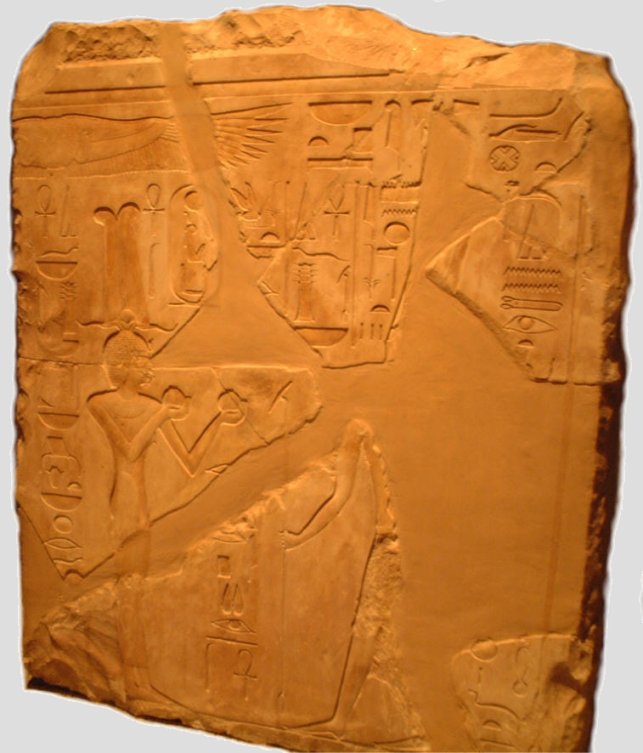
|
The limestone block shown above was found 1930 at Karnak by the French excavator H. Chevrier. The block belongs to another
dismantled chapel - probably a monument of Thutmosis II (Aa-cheper-en-Ra)
-, from which only very few fragments had survived. The original position of
this chapel in district of Karnak as well as its appearance is unknown.
Today this block is exhibited in the museum of Luxor (Courtesy: M. Jennrich).
|
|
The scene shows Hatshepsut offering wine (in the round containers) to Amun-Ra, a scene, which is reserved
to the king. She carries here the high Atef crown (king's crown of double
feathers, sun-disk and ram horns), which associates the king with the sun God. Otherwise the representation is, however, typically female, with the long dress, which reaches
down to the feet, and the almost closed position of the feet. However, the female is clearly identified
by the titles "King of
Upper and Lower Egypt" and "Lady of the Two Lands", Maat-ka-Ra. Despite the otherwise female attire
this indicates
that she already had made an important step to the throne.
|
| New hypothesis about the development of the temple at the beginning of the 18th Dynasty
|
| The description of the development of the central area of the
Karnak-temple presented above corresponds with the traditional view of the
historic course of events. |
| With regard to the construction work during the early 18th
Dynasty Larché has presented some years ago a new hypothesis on the basis
of recent excavations in the temple (Larché, F., Nouvelles observations sur
les monuments du moyen et du Nouvel Empire centrale dans la zone du temple d'Amon. Cahiers de Karnak XII, 2007, p. 407-496; Larché, F., A
Reconstruction of Senwosret I's Portico and of Some Structures of Amenhotep I at
Karnak. CHANE 37, 2009, p. 137 - 173). The new excavations of the central area
of Karnak temple in 2005-2006 were made possible by the
Luxor Dewatering Project. In some places his new
hypothesis based on new findings differs radically from previous ideas.
|
| According to this hypothesis:
|
| - the original Middle Kingdom (MK) temple was most likely directed to the
East (e.g. Larché 2009, p. 9 ff). Amenhotep I changed the orientation of the temple from East
to West (possibly because the connection to (branch of) the Nile on the eastern side of the temple
got lost) |
| - the MK-temple built by Sesostris I was already
dismantled by Amenhotep I or at the latest by Thutmosis I (and not by Hatshepsut)
because Thutmosis I. reused fragments of Sesostris I's colonnade in the
foundations of his own colonnade in the courtyard of the 5th pylon (e. g. Larché
2009, p. 17).. |
| - the 4th pylon and the Wadjet-hall (traditionally attributed
to Thutmose I), the 1st pair of obelisks in front of the 4th pylon (decorated in
the name of Thutmose I), as well as a precursor of the 3rd pylon and the
adjacent Festival Court (both attributed traditionally to Thutmose II) were all
built by Hatshepsut |
| - the encasement of her obelisks (erected in the Wadjet-hall)
was already done during the reign of Hatshepsut (and not during the persecution of
the queen under Thutmose III) probably for technical or religious reasons (Larché
2007, p. 458ff). |
|