|
Karnak-Temple |
last update:
21.11.2013
|
| |
"Palace of Maat" - North-Chambers of Hatshepsut
|
|
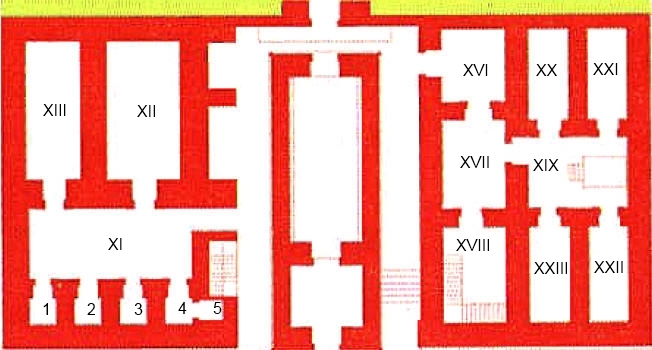
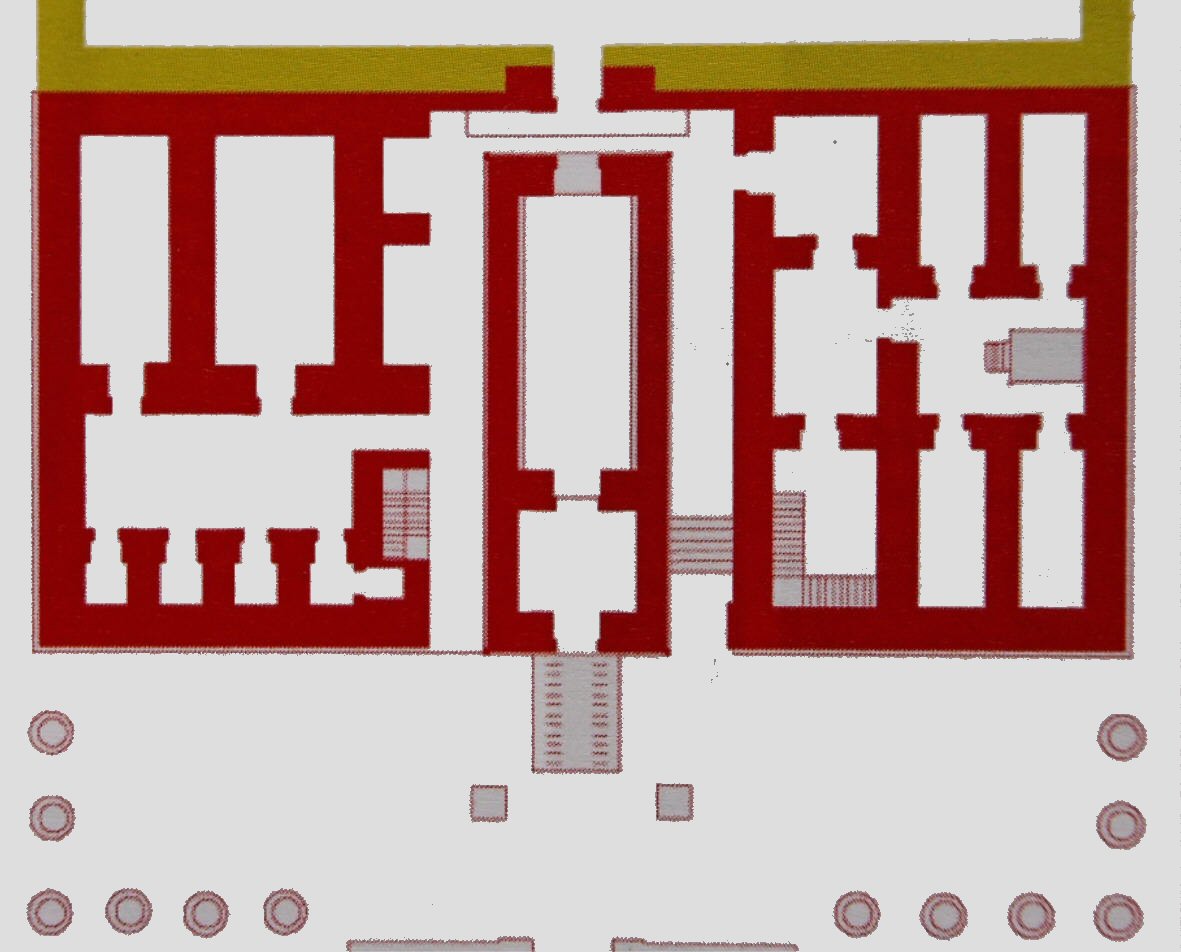
The floor-plan above shows the
arrangement of the chambers of Hatshepsut around the Red Chapel. According to
Porter & Moss II, Theban Temples, the rooms are with Latin numbers; the rooms
numbered 1-5 on the north side are not numbered in Porter & Moss. The walls
painted in yellow mark the boundary wall of the Middle Kingdom Court.
The floor plan is a modified excerpt from Burgos, Larché, La
Chapelle Rouge, 2008, p. 337, extension phase (C) under Hatshepsut. |
| Antechamber (Porter&Moss Room XI) |
|
Today, one has to walk around the sanctuary erected by Philip Arrhidaeus to
reach the Northern chambers. Presumably, most visitors to the temple of Karnak
have visited these rooms – at least partly. |
|
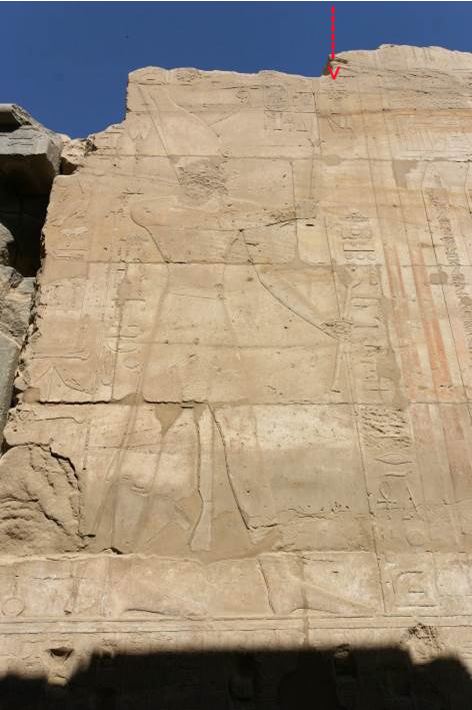
The southern outer wall of the chambers impresses immediately with the list of
offerings consecrated by Thutmose III (above the beginning with the offering of
two obelisks). Right next to the cartouches of the king there is one of three
contemporary sources of the name "Palace of Maat" (red arrow), i.e. Thutmose III
inaugurates his offerings to Amun in the "Palace of Maat". |
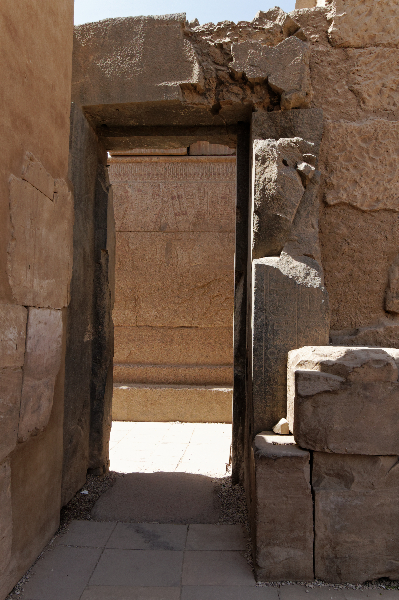
| A dark-granite door gives access to the Northern Chambers.
Originally, this door had been the eastern gate of the Red Chapel - it was
reused here and decorated in the name of Thutmosis III.
|
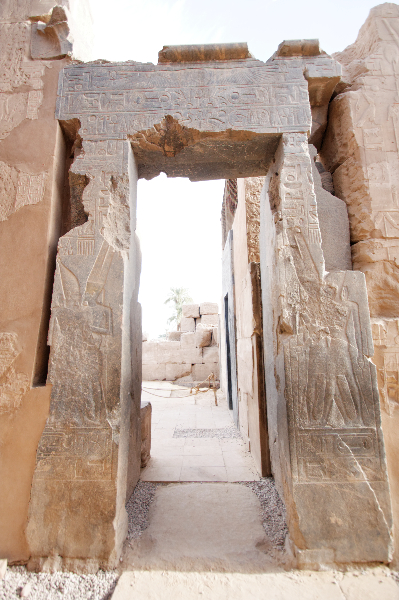
| Entrance to the Northern Chambers. The granite-door had been
originally the eastern door of the Red Chapel and was reused by and decorated in
the name of Thutmosis III. The architrave shows titles and names of Thutmosis
III, on both sides the king is embraced by Amun. |
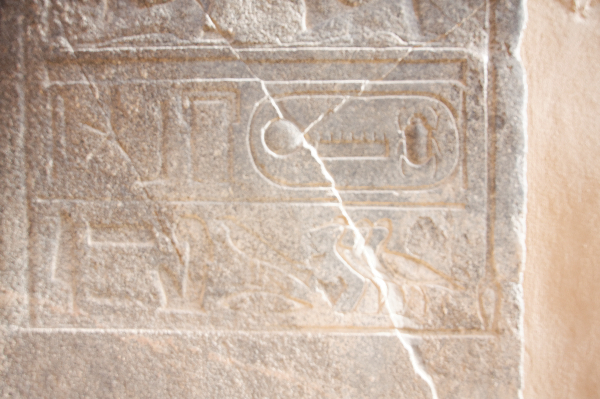
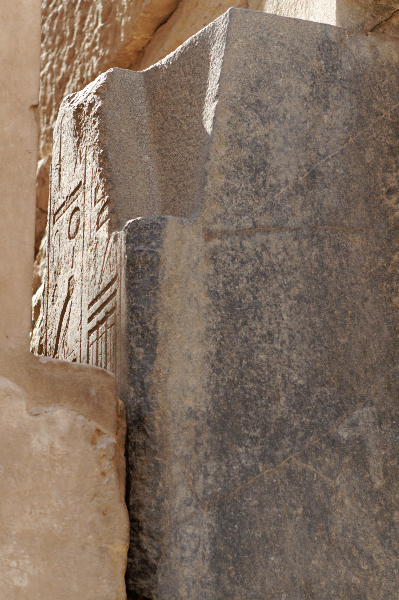
| On both jambs the final lower parts of the decorations shows
the door-name: "sbA Mn-xpr-Ra Imn wr bA.w =
Door of Men-Kheper-Ra [with the name] Amun, great with Ba-power"
(see photo above). According to Grotthoff (Grotthof, Th., Die Tornamen ägyptischer
Tempel. Aegyptiaca Monasteriensia 1, Aachen 1996; S.94) the is the original
door-name by Thutmosis III. |
| The door leads into the antechamber (Porter&Moss, R XI) which gives access to the two eastern chambers XII and XIII and to
the smaller rooms 1 to 5 on the western side.
|
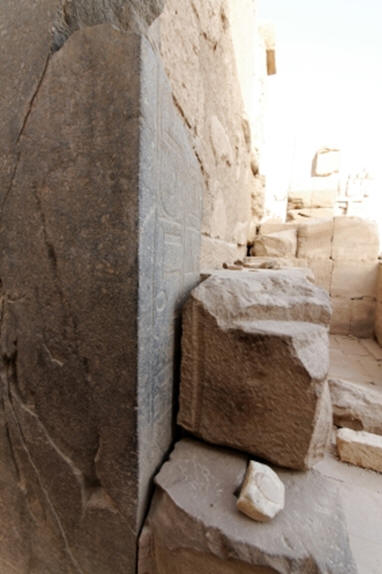
| Both photos above show the heavy damaged inner side of the
door. The decoration of the left jamb is nearly completely concealed by the
western wall of rooms XII und XIII. |
|
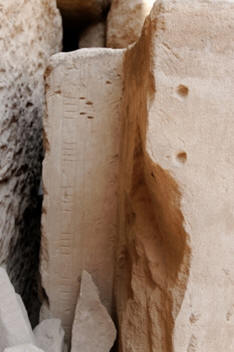
A look on some architectural details (left photo) reveals that the wall with the
text of Annals, the granite door, and the wall with the offering list of
Thutmosis III were erected in front of the original southern wall of the
chambers. |
|
The is also confirmed by an inspection of chamber 5. This reveals that the
southern wall of the chamber contains a window which is now "closed" by the wall
with the Annals. The frame of the window still shows traces of the original
decoration with a colored band. |
|
Little of the original decoration has been preserved on the walls of antechamber
XI. Beside the entrance to Room XIII is a representation of Tuthmosis III
before a table with offerings (below). Remains of offering tables are also
preserved at the northern inner wall. |
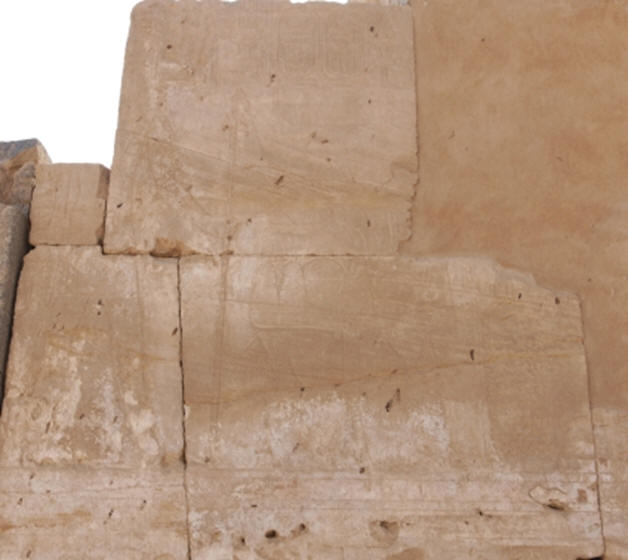
| East wall of Room XI, between Rooms XIII (left) and XII
(right): Thutmosis III (left holding a staff) in front of a table with gifts. |
|
The northern chambers are severely destroyed. From the western chambers 1 - 5
most of the walls have only survived to a height of about 1 m, the decoration of
these walls is nearly completely lost. |
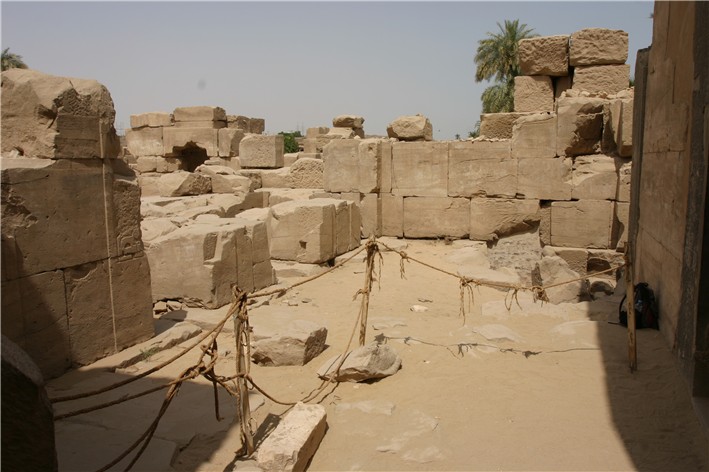
| View of the northern chambers of Hatshepsut, on the left the
remains of the chambers 1 - 5, on the right the two chambers 6 and 7. |
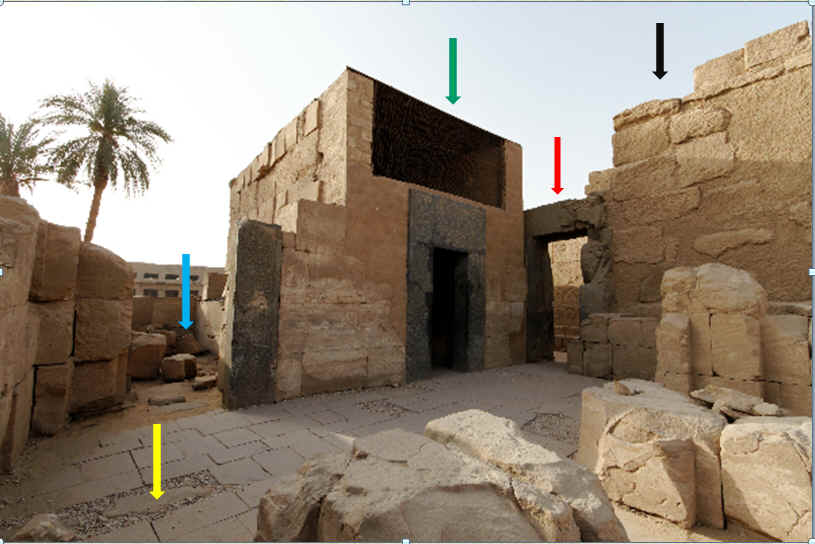
| View in the northern chambers from West to East (in the
background the Akh-menu), in front the remains of the Chambers 1-5, across the
two rooms XII and XIII. The red arrow points to the above gate of Thutmose III,
the green one to Room XII, the blue one to Room XIII, the yellow arrow points to
a remnant of the original floor in the antechamber Room XI, which shows the same
decoration as the floors in the rooms 1-4 (see following photos), the black
arrow points to the rear wall of the "Annals" text. |
|
Enough stones of the floors have survived to reconstruct the decoration in
chambers 1 - 4 as well as in the antechamber
(see Burgos and Larché, 2006). Obviously, there are no findings concerning the
floor-decoration in chambers 5 - 7. |
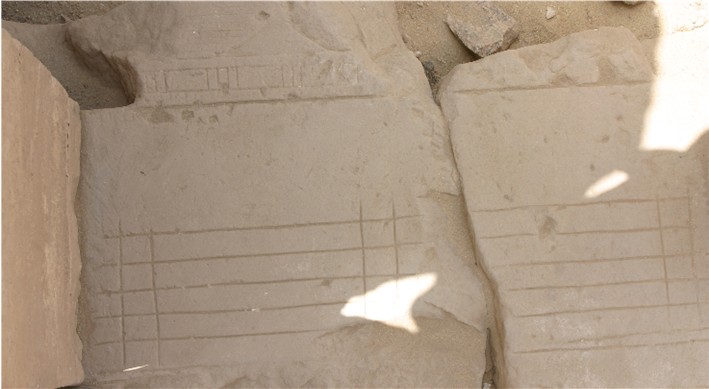
|
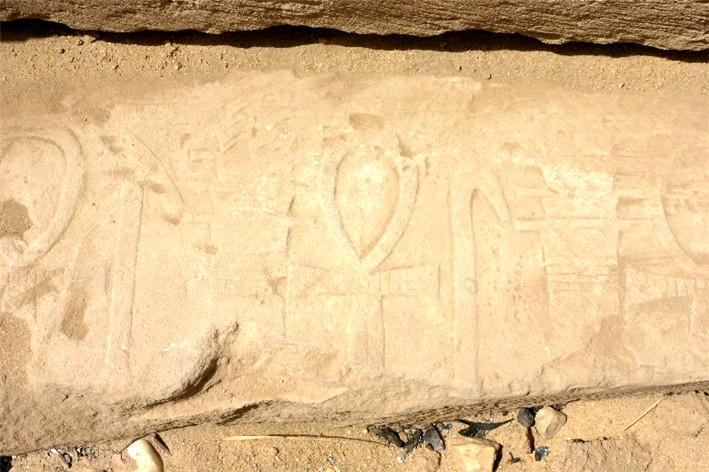
Eye catching is the decoration of all threshold to chambers 1 - 4 with the
pattern shown above. The block shown is still in situ forming the threshold of
the entrance leading into chamber 3. |
|
The floors of chambers 1 - 4 as well as the floor of the antechamber had been
decorated with a pattern that consisted of a wAs-sign on the left, a
Dd in the middle, and an anx-sign on the right all mounted
together above a nb-Zeichen - which read together as: "All
happiness, all stability, all life": The block shown above has lost its
nb-signs. This pattern repeated oneself and covered the floors completely.
According to Burgos and Larché
(2006) the pattern inside the chambers had been aligned with the nb-signs
facing east whereas in the antechamber the signs were facing west. |
|
The walls of the chambers are strongly destroyed. Since they had been decorated
only from about 1 m above the ground, almost nothing remains of their
decoration. A cartouche of Thutmose II is preserved on the right outer door jamb
of Chamber 1 in the North West corner - probably usurped from Hatshepsut. |
|
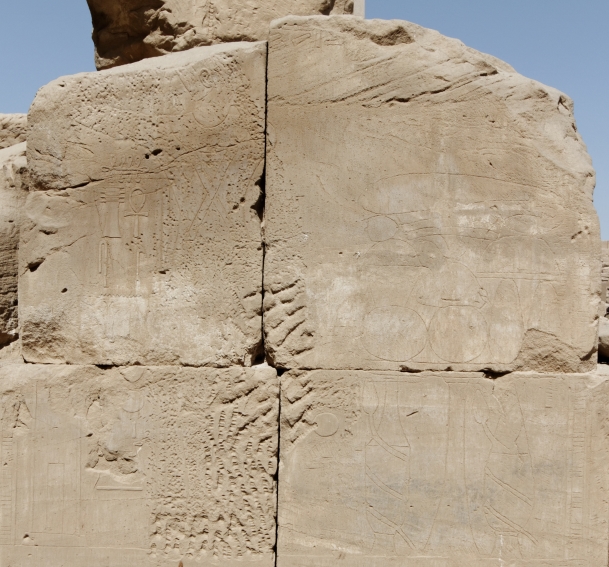
Nevertheless, it is worth to look into the two chambers 2 and 3 where few
remains of the wall decoration have survived. The following photo of the rear
wall of Chamber 4 shows - on the left side - the remains of an ithyphallic Amun
(the figure has been chiseled out) standing in front of an offering table
(right). The side wall to Chamber 3 shows on both sides still recognizable
remains of god, king and offerings. |
| Chambers 6 and 7 (Porter&Moss Room XII and XIII) |
|
The two eastern chambers 6 and 7 (Porter&Moss Room XII and XIII) give the impression, as if they have had "survived" into modern
times as they can be seen today. Today the two chambers are separated by a
wall which however is not the original one because it previously had been the right exterior of the right chamber.
|
|
When Mariette started the first attempt in the 19. century "to clear
up" the area, he discovered that directly behind the wall of the
"Hall of Annals" of Thutmosis III an original wall of
Hatshepsut, covered with a colored relief - Thutmosis III had simply
erected a new wall of sandstone in front of it and inscribed his annals on
the new wall (see also: Barguet, Le Temple
d'Amon-Re à Karnak, 1962, p. 148-153). The relief of Hatshepsut already showed clear attempts to extinguish
her memory - by rough chisel the raised relief, e.g. the figure of
Hatshepsut, was eliminated. In addition, it shows first attempts to
re-assign the inscriptions, recognizable by finer and flatter chisel impacts,
with which one tried to smooth the area of
her cartouches again.
|
|
According to Dorman (1988) the "Hall of Annals" of Thutmosis III can
not have been built and decorated before his regnal year 42 - therefore, one could
deduce a late start of the persecution of Hatshepsut from the fact that the wall
has not yet completely redecorated.
|
| When the French Egyptologists detected the implications of the wall, they
decided to split the blocks. The side of the blocks with the
relief which had been covered so far by the wall of the "Hall of
Annals" were used in place of the missing block of the left chambers
to re-erected the partition. Using the other half of the original blocks
the rear side was set up again at the old place, just as the wall of the
"Hall of Annals" of Thutmosis III.
|
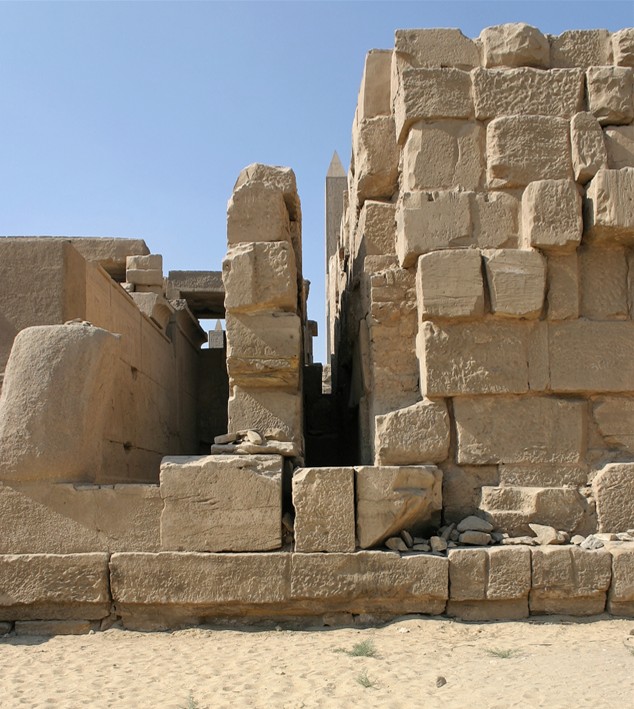
| The photo above shows the rear side of the chambers of
Hatshepsut (on the right chamber 7) and the barque shrine of Philippos Arrhidaios
(left). Between the barque shrine and chamber 7 from left to right: the passage
to the northern chambers, the wall of the "Hall of Annals" of Thutmosis III, the
gap which resulted from splitting the wall of Hatshepsut, and the remaining
blocks of the southern wall of chamber 7 (photo: E. Noppes). |
| Chamber 7 (Porter&Moss Room XII) |
| The eastern wall of room 7 shows no original details anymore. |
| The North wall of the room shows well-preserved colored reliefs
and is a destination of numerous tours in the Karnak Temple. Each of the two
registers contains three scenes. |
| In the right (eastern) scene of the upper register, Hatshepsut is led by
Atum and Monthu to Amun.
|
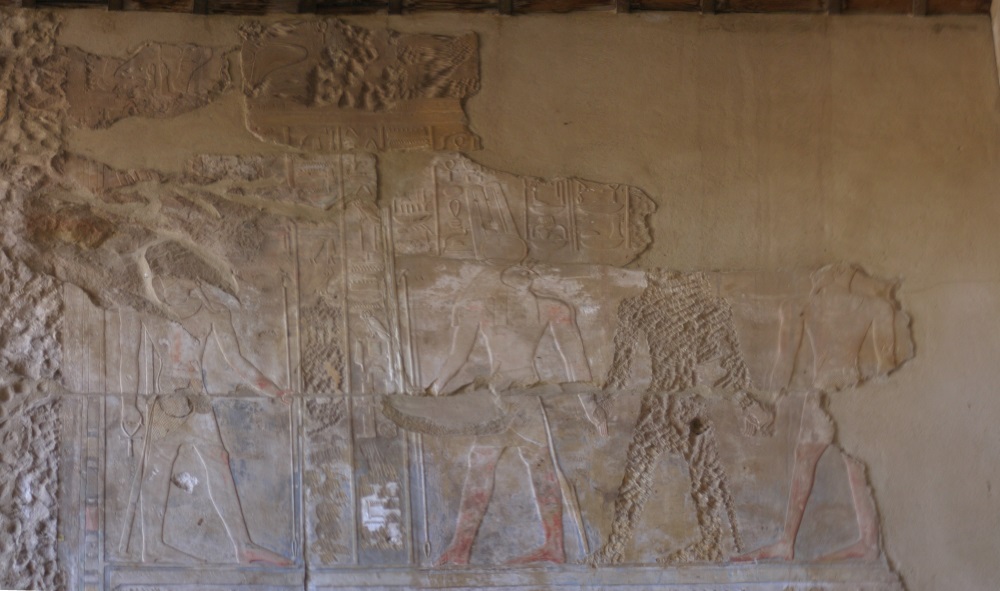
| In the central scene Hatshepsut, followed by her Ka, is shown
consecrating offerings to Amun, (see following photo). In the third, left (western) scene,
she stands with a heap of offerings before the ithyphallic Amun.
|
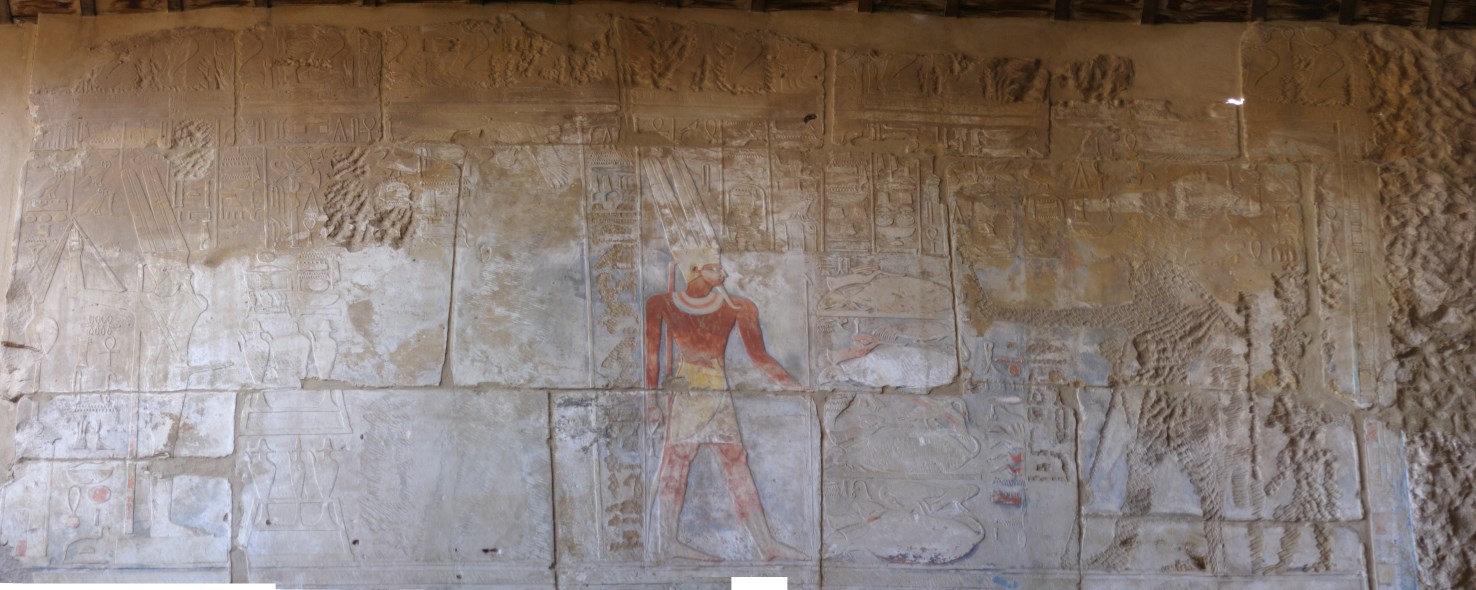
| Above the register the remains of destroyed cryptograms of Hatshepsut
(which
formed the conclusion of the wall to the ceiling) are still visible. |
| For the following photo the three scenes of the lower register
were assembled from single images to provide a complete view. |
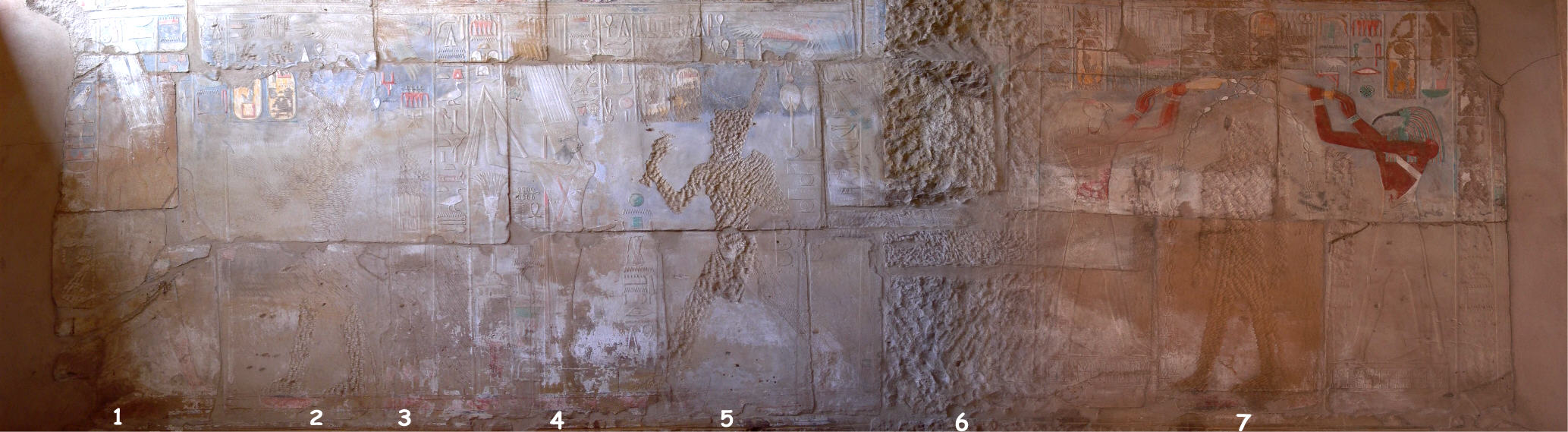
Above the lower one of 2 registers of the original wall of Hatshepsut which had been covered by the wall of the
"Hall of Annals" of Thutmosis III
on the left - hardly discernable - Hatshepsut (2) offers in front of Amun (1), behind
her there is as small figure, her Ka (3);
right of this scene Hatshepsut (5) - with a
Hst-vase
in each hand - is shown running towards the ithyphallic Amun (4) to offer "Water" (the same scene is
shown on a block of the
Red Chapel - see next picture);
in both scenes her figure was hacked away and her cartouches were partly destroyed;
further right (6) the remains of a side wall are discernable
far right (7) Hatshepsut is purified by Thot (right) and Horus (left)
who pour Ankh-signs over the queenA double click on the picture will load a
page with a high resolution version to view more the details (a double click on
the high-resolution photo leads back to this page). |
| On this wall all representations of the Queen and most of the
time also her cartouches are deliberately destroyed. All representation of gods
are, however, not damaged, i.e. after the construction of the wall of the annals
by Thutmose III these scenes were no longer accessible for the iconoclasts of
the Amarna period and remained therefore unchanged. |
|
At the very right edge the photos above show the remainders of a side wall
(perhaps of a transverse wall or a spur).
This wall was probably taken down by Thutmosis III during the erection of his new bark shrine. Earlier,
this remainders had been interpreted as remainders of a transverse wall.
However, with a transverse wall in place there would not have been enough space
for the Red Chapel in the center the chambers. Therefore, the remainders had
been the reason for the fact that
for some time the original position of the Red Chapel was located in front of
the "Chambers of Hatshepsut". |
| Today these remainders are interpreted as a part of a spur and
the Red Chapel is now reconstructed in the center of the "Chambers of
Hatshepsut" (see below detail taken from Burgos, Larché, 2008, plan page 254). |
|
The opposite southern wall of room 7 shows also in two registers representations
of the Queen. Again, above the register the remains of destroyed cryptograms of Hatshepsut
(which
formed the conclusion of the wall to the ceiling) are still visible. |
| The upper register (Porter & Moss, register I) shows (from
right to left) the queen (cartouches changed to Thutmose II or III) in two
scenes before the striding Amun (right) and his ithyphallic manifestation
(center), and in the third (left) scene (cartouche changed to Thutmose III) with
an offering list and gifts before Amun. |
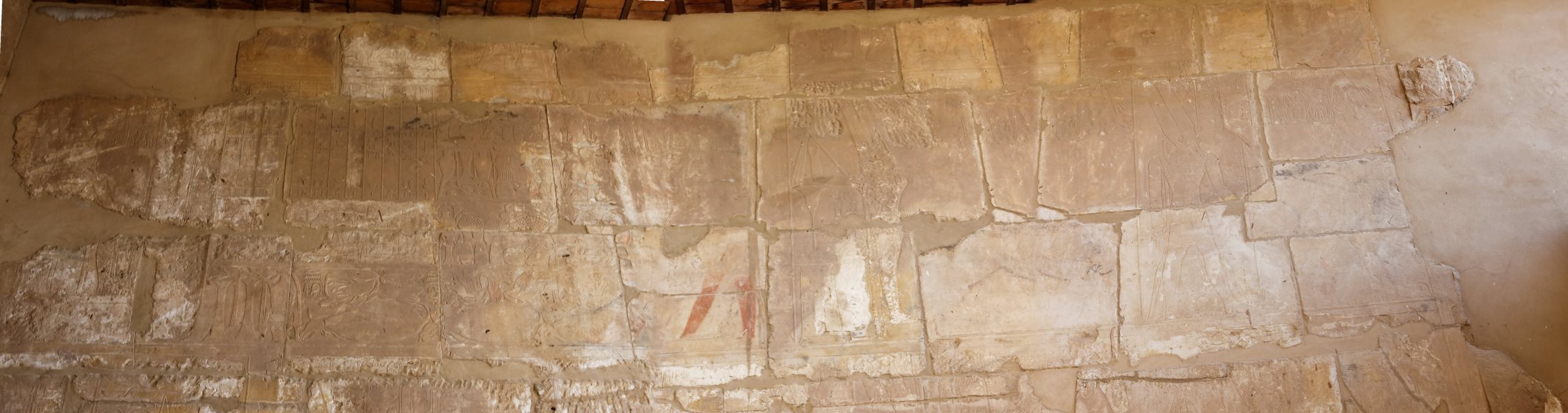
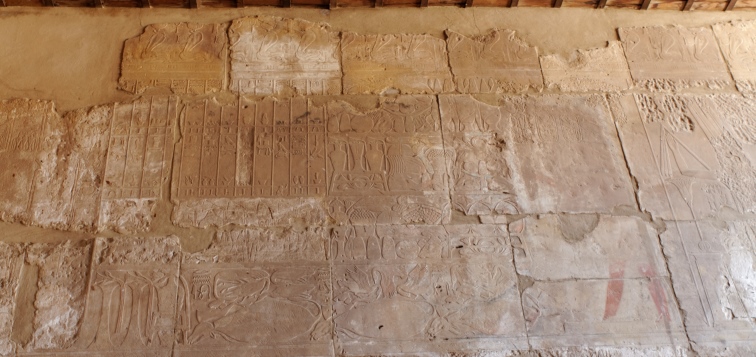
| That also this wall was once built for and decorated by
Hatshepsut is proved by the fries with herr cryptogram above the list of victims
of the upper register. |
|
Room XIII is largely destroyed and most of the time not accessible. A part of
the right jamb of its entrance is still in place, pieces of its architrave are
scattered in the area – both remains were decorated in the name of Thutmose II.
The interior walls of Room XIII were up all decorated from chest height so that
from the right interior wall, except one block, only the lower, undecorated
stones are left. From the decoration of the two smaller sides remains only
traces of bands of color are preserved on the inner side of the door. The
following photo shows the entrance to this room. |
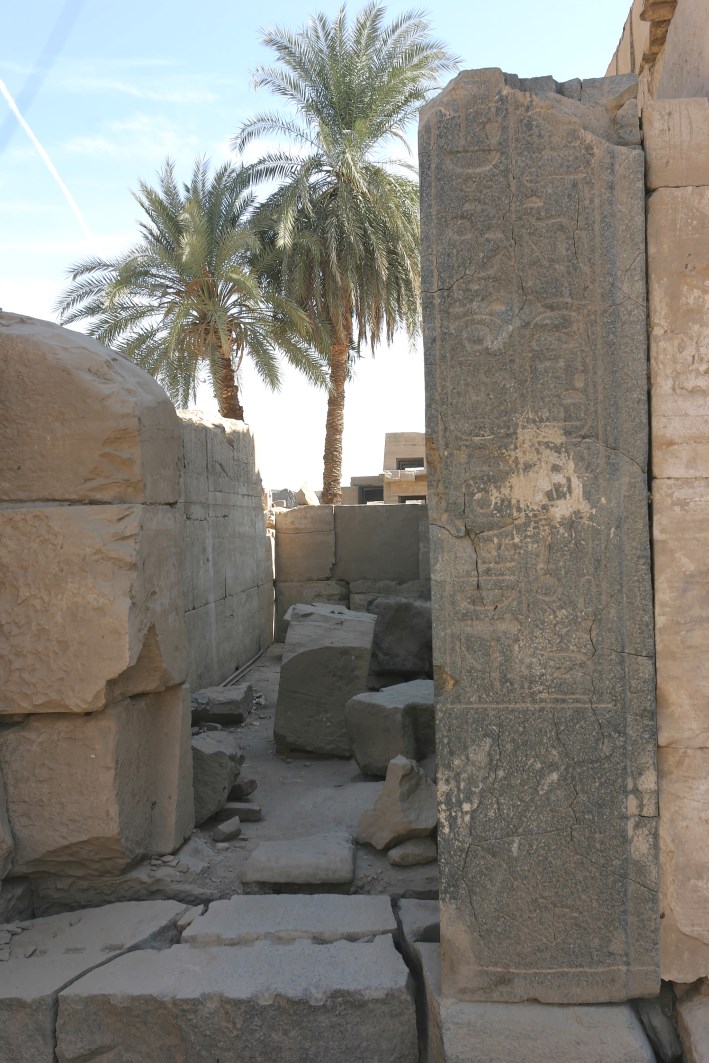
| Entrance to Room XIII. The floor is scattered with fragments of
dark granite among them parts of an architrave. A big part of the right door
jamb is still in situ showing titles of Thutmosis II.
(according to: Porter&Moss, loc. cit.). |
 |
|
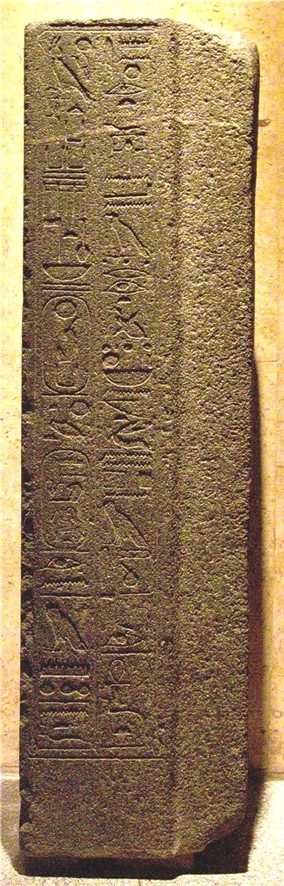
The Luxor-Museum exhibits this door-jamb showing the titles of Hatshepsut.
Perhaps it
would fit into the entrance of Room XIII.
According to the description at the Luxor-Museum the block originates from
a magazine of Hatshepsut at
Karnak-temple which was used to store myrrh.
|
| On the northern inner wall of Room XIII
have
been
preserved
from
about
chest height above.
|
Porter&Moss II, p. 103, No. 304, describe the scenes as follows:
„[Queen with Ka] libating to the Great Ennead“
referring to Urk. IV 576 (182) „[…daß Du] [Gottes]häuser [baust],
Gottesbilder bildest und die (Opferbrote bestimmst […auf] dem Horusthron, dem
ewig Leben gegeben werde.“, and also to Barguet, Temple, 151, who summarily
mentioned „Offerings to the Great Ennead of Karnak [of which still nine mummiform
gods are depicted sitting in the lower register]“. |
|
Strictly speaking the document quoted by Porter&Moss is "Blumenthal, Müller, Reineke, Urkunden
der 18. Dynastie, Übersetzung 5-16, Berlin 1984, S. 144",
and differing from Barguet only 8 seated gods are still recognizable.
|

|
The
photo
shows
a
panoramic view
of the
scenes of
the northern
inner wall which was prepared from
multiple pictures.
A
double click
on
the
picture loads
to
a
high resolution
version
so that
more
details may b viewed
(a
double click
on
the
high-resolution
photo
leads
back
to
this
page).
|
On
the
left
side
the
legs
of the king
have survived,
right
before
him
numerous
offerings are depicted.
Left of
the king
there would be space enough to depict his
Ka
but
there
is
hardly
anything identifiable.
The row
of
8
seated
deities
in
the
Hebsed-robe starts
with
the
4th
(from left) block. All seated deities are
separated
by
a
vertical
inscriptions.
Five columns contain a cartouche
which may be easily
completed to or may be read
as
the
throne name
of
Thutmose
II
(1 x)
or
Thutmose
III
(3 x)
or birthname
"Thutmose".
|
The
outer walls
of the
Northern
Chambers
offer
nothing
spectacular with one
exception
one
on
the North
side.
There, a short part of the original inscription
of Hatshepsut
has survived that tells us when the
rooms were
build
-
namely
in
the
year
17 (right,
bottom row).
|
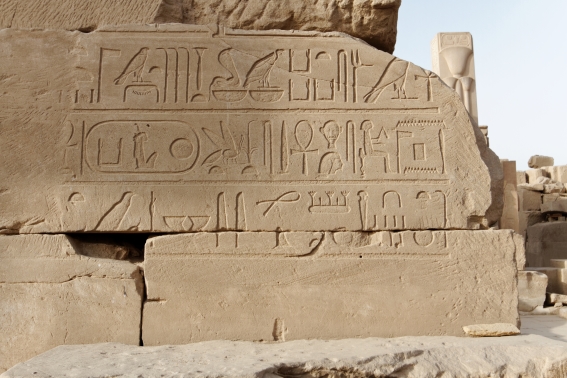
The
inscription
preserved
was
part of
the
decoration
which
continued
East
over
the
entire
outside.
This
part
has
only been
preserved
because
Thutmose
III erected
built
a
gate here. The
Western
jamb
(see
below)
covered
the
inscription
-
the
remaining
part of
the
wall
has been
smoothed
but
not
decorated again.
|
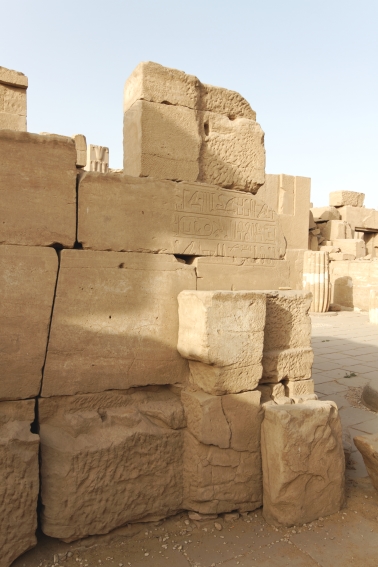
Exterior wall of
the
North Chambers
with
the
inscription
of
Hatshepsut
and
the
remains
of the
gate
which
had
been
placed
here
against
the
wall
(and
the
inscription)
by
Thutmose III.
The
rough-hewn
blocks of
the
lower
stone row are part of
the
"Podium
of
Hatshepsut".
|
|