|
Maat-ka-Ra Hatshepsut |
last update: 09.12.2010 | |
|
History |
| Period: | 18. Dynasty | ||||||||||||||||||||||||||||||||||
| Birth Name: | Hatshepsut "Foremost of noble women" (@At-Spswt; 1. cartouche) or "Foremost of noble women, united/imbued with Amun" (@At-Spswt-xnmt-jmn; 2. cartouche) |

|
|||||||||||||||||||||||||||||||||
| Throne Name: | Maat-ka-Ra (MAat-kA-Ra) "Truth and Vitality, the Ra" or "True one of the Ka of Ra"; also the reading: |

|
|||||||||||||||||||||||||||||||||
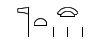
| Golden Horus Name: | Divine of Appearances (nTrt-Xaw) |
 |
|||||||||||||||||||||||||||||||||
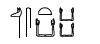
| Horus Name: | Powerful of Kas (wsr.t-kAw) |
 |
|||||||||||||||||||||||||||||||||
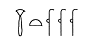
| Nebty Name: | Flourishing of Years (wADt-rnpwt) |
 |
|||||||||||||||||||||||||||||||||
| Reign: |
arranged according to the first year of the reign |
||||||||||||||||||||||||||||||||||
| Father: | Thutmosis I (Aa-kheper-ka-Ra)  |
||||||||||||||||||||||||||||||||||
| Mother: | Ahmose | ||||||||||||||||||||||||||||||||||
| Husband: | Thutmosis II (Aa-kheper-en-Ra)  |
||||||||||||||||||||||||||||||||||
| Daughter: | Neferu-Ra | ||||||||||||||||||||||||||||||||||
| Tomb: | KV 20 | ||||||||||||||||||||||||||||||||||
| Age: |
the age of Hatshepsut is discussed in more detail at the end of this page |
||||||||||||||||||||||||||||||||||


| The royal names of Maat-ka-Ra Hatshepsut |
| After her accession to the throne Hatshepsut was represented almost
during her entire reign in the traditional form of a male king. Her titles were however written grammatically in such a way that
her female sex was clearly recognizable A first look shows that the construction of her titles follows traditional rules and consist of quotations of the titles of earlier kings. This can be demonstrated on her Horus name: the name consists of two parts, wsr.t and kAw. The male form of wsr.t, wsr = "powerful" was already used e.g. in the Horus name of Chefren (wsr jb), in the Nebty name of Rahotep (wsr rnpt; 17. Dyn.), and in the Golden Horus name of Sobek-hotep (wsr-bAw; 13. Dyn.). |
| The part kA (here in the plural form kAw) was in use since the early 18. Dynasty. All Thutmosid kings, Thutmosis I to III, used the surname kA nXt = "strong bull". Since "strong bull" was hardly suitably for a queen and could not easily transferred into a "suitable" female form ("strong cow"?) it is assumed that Hatshepsut used the kA to construct a connection to the royal Ka - particularly to the manifestation of the royal Ka as the "first of all living Kas" (= xntj-kAw-anxw). |
| Robins (Robins, G., "The Names of Hatshepsut as King", JEA, 85, 1999) showed in his investigation that her names were formulated in such a way that they contain references to various goddesses, probably to stress the "divine" character of her kingship and her legitimacy. The following sections show some of these references as described by Robins. |
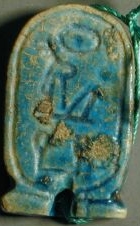
| The photos below show an amulet made of faience (glazed steatite, bright blue), today in the Petrie-Museum, London. On side is inscribed with her Throne name Maat-ka-Ra (left) and the other one with the Horus name Weseret-kau (right). |
 |
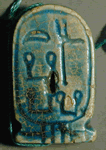 |
| mAat-kA-ra Petrie-Museum, London, UC11974 | wsr.t-kAw, Petrie-Museum, London, UC11974 |
| The Nebty name: "wADt-rnpwt" = Flourishing of Years" contains the goddess of lower Egypt, Wadjet (wADt, Uto). |
|
The Horus name: "wsr.t-kAw = Powerful of Kas" contains the name of the goddess "Wosret" (wsr.t). Since in the Nebty name contains the name of the goddess of lower Egypt, one could expect the Horus name to contains - normally placed in the in front - the goddess of upper Egypt, Nechbet. However, it contains the name of the local goddess from Thebes, Wosret, that was also part of the name of Senwosret (= S'en- weseret = "Man of the goddess Wosret").Most likely the name Wosret or Weseret is a surname of Hathor. In addition, the use of the names of two goddesses in the Nebty and in the Horus name results in a reference to the "duality" of Egypt, by that repeating the same notion in "The Two Ladies" (nbtj) and in "Lord of the Two Lands" (nsw bjtj). |
| The Gold Horus name: "nTrt-Xaw = Divine of Appearances" is the generic name for a goddess (nTrt) and has no geographic reference. |
| It must be emphasized that this type of wordplay as demonstrated by Robins was only possible because Hatshepsut could make use of the grammatical gender in writing her names. |
| How old was Hatshepsut? |
| The ages of the many kings of ancient Egypt can only be estimated. Even the mummies of the New Kingdom which were identified did not contribute very much to the determination of their age - in contrast, the attempts to determine the age of a mummy with scientific methods served to confuse the situation. The scientific determination of age resulted in remarkable contradictions to well-known historical data (duration of the reign and/or life) from identified royals. This could mean either that the identification of a mummy in question is false (mistakenly labeled during the rescue and restoration in Dynasty 21) or that the present scientific methods are still incorrect - possibly also both applies. |
| How old Hatshepsut might have been at some events during her life has been usually extrapolated on the basis of several assumption - because also her mummy was missing. |
| However, since the Egyptian Supreme Council of Antiquities (SCA) has "identified" the mummy named KV60-A ("Where is the mummy?") as the mummy of the Hatshepsut the data collected on this mummy allow some extrapolations about her age at different events which are presented on the page "How old was Hatshepsut?". |
| . |