|
The Solar Complex on the 3. Terrace of the
Temple Djeser djeseru |
update:
20.03.2015
|
|
The solar cult complex consist of a roofed vestibule and an open
courtyard with the sun-altar. The predominating element of the
sun-court is the great open-air altar for Ra-Horakhty erected in its center and equipped with
stairs leading on its western side up to the platform. The walls to
the northern chapel of Amun and to the courtyard of the 3. terrace
both show a niche. The remains of a 3rd niche have been discovered
during the excavation and restoration work. Obviously, the 3rd niche
had been dismantled when Hatshepsut added the Upper Chapel of Anubis
(Szafrańskj, 2001).
|
|
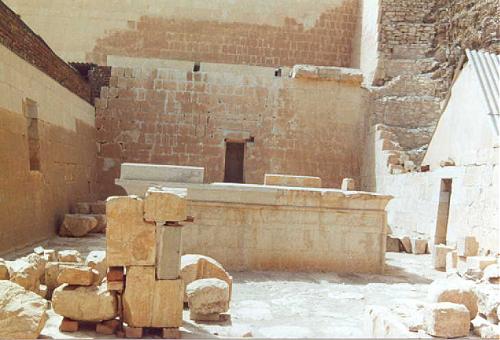
|
| Above the Sun Altar seen from the vestibule (position 11
in the floor plan above which itself
is not accessible for tourists). On the right side the upper Chapel of
Anubis, opposite on the western wall and and on the left wall the two niches. |
|
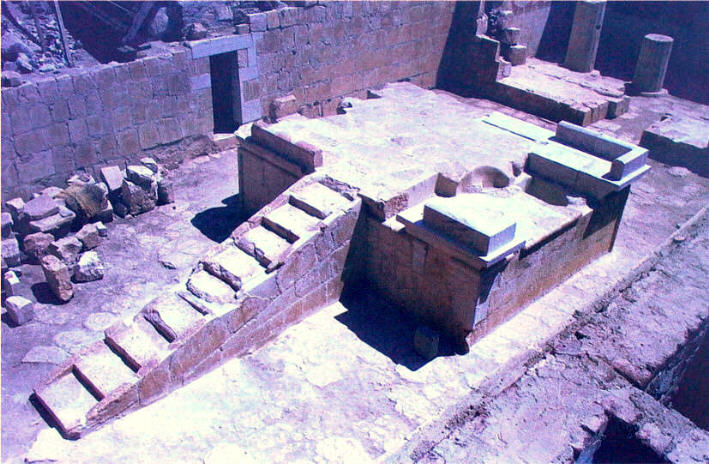
|
|
View of the Sun Altar from the wall separating the sun-court from the
main part of the 3rd terrace. On the right upper corner the remaining
walls and columns of the vestibule (photo taken from: Szafranski, 2001, p. 264).. |
| Wyzocki (MDAIK 43, 1987, and MDAIK 48, 1992) was first one who
tried to provide a history of its building on the basis of the investigations of
the Polish mission. After his interpretation the Solar
Complex had been erected in 2 phases with several planning stages: |
| - according to Wyzocki the 1st phase had been carried out only
in parts.
According to the plans the Northern Chapel of Amun was the only enclosed room on
the northern side of the festival court at that time.
A colonnade with an ambulatory on the planned southern, eastern, and northern
walls of the Solar Complex were not installed.
|
| - in the 1st stage of the 2nd phase a yard or a hall with
columns was planned east the northern chapel of Amun, with one entrance each at
the Northern Chapel of Amun and at the "Night-Sun Chapel". If this plan had been
implemented 12 columns before would have erected in front the Upper Chapel
of Anubis - at this time probably an impressing element of the festival court.
|
| - in the 2nd stage of the 2nd phase the idea of a columned hall
was rejected in favor of an open court, at the same time " Night-Sun Chapel"
established.
|
| - in the 3rd stage the Sun altar as well as the stairs leading
to its floor were enlarged (see photo below). |
|
The walls of the courtyard had not been decorated, the niches were
most likely intended to worship Hatshepsut.
|
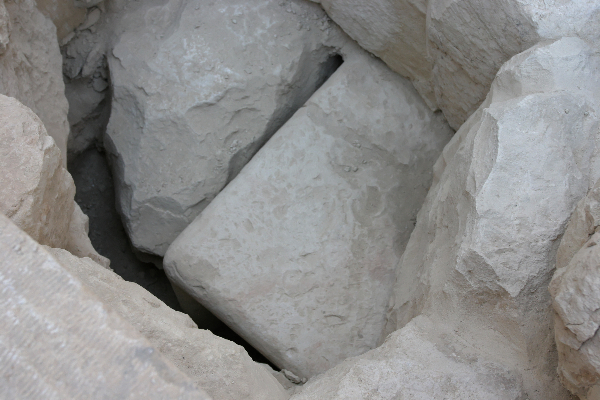
| The investigations of the Polish team revealed that the Sun
altar had been enlarged whereby the old altar had been just built over. |
| However, re-examination of the Polish archaeologists showed
that the ideas of Wysocki concerning the building history must be rejected (Karkowski, 2003). |
| The results of the re-examination showed that from the
beginning the rooms on the
northern part of the festival court contained a Solar Complex
with an open altar court and a roofed "Night-Sun Chapel".
|
| The original plan has been slightly modified. A more important
modification was the addition of the "Upper Chapel of Anubis", another one the
repeated moving of the "Night-Sun Chapel" from its original position on the east
to the west side of the altar court and then back to the east. As a rule, these
modifications required the demolition of some walls. |
| The niche in the northern wall of the open altar court was dismantled when the "Upper Chapel of Anubis" was added (Szafrańskj, 2001).
|
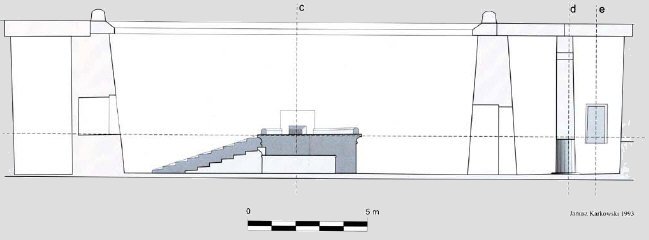
West-East cross section of the final scheme of the Solar Complex (from: Karkowski, 2003, plate 14C).
The figure shows the "Night-Sun Chapel" to the east (right) side of the altar
court, the central altar which was enlarged (built over), behind the altar the
northern wall with the entrance into the "Upper Chapel of Anubis", and the
western (left) wall with the niche.
The figure shows that the bottom of the
niches were on the same level as the upper surface of the altar. |
| Based on the observation that the decoration of the
"Upper Chapel of Anubis" includes representations of Thutmosis I the addition of
the chapel is dated into the late period of Hatshepsut's reign. |
| The investigations of the Polish team showed that figures of
Thutmosis I replaced three times figures of Neferu-Ra already during the reign
of Hatshepsut. This is associated with the observation that Neferu-Ra
disappeared from the records after year 11 of Hatshepsut. |
| On the other hand, the increased appearance of Thutmosis I
among the temple's decoration may also be associated with the transportation of
his mummy to KV20 (Karkowski, loc. cit., S. 48) - if one agrees that his
original tomb was KV38 and not KV20. |
| The investigations showed that merely the "Upper Chapel of
Anubis" and the "Night-Sun Chapel" had been decorated completely.
|
| The walls of the solar court had been roughly smoothed by
chisel strokes but not polished thereafter. The walls had not been decorated. |
| The decoration of the two niches of the solar court as well as
the inscription of the altar had never been colored. |
|
Destruction and Restoration
|
Apart from the destruction of representations and names of
Hatshepsut under Thutmosis III, later the names and figures of Amun(-Ra) and the
Gods of the crew of the solar barque (Saryt, Thoth, Wepwawet, Lady of the Barque,
„Bull of the truth Ka-Ma'at" and Sia) were attacked - with exception of Ra-Horakhty
and Atum - during the Amarna period.
The destroyed figures and names of gods were restored - most probably under Horemheb. The well preserved figure of
Amun-Ra on the western jamb of the entrance may show the facial features of
Horemheb.
|
| Among the original decoration only the kings Hatshepsut and Thutmosis III
had been depicted (Karkowski, loc. cit. p. 59), during the destruction of
figures of the queen here and again she had been replaced by figures of Thutmosis II.
|
| Due to the numerous destructions not all scenes could be
reconstructed.
|
The original plan contained most likely 6 niches:
- one each in the southern, western, and northern wall of the altar court;
the niche of the northern wall was dismantled when the "Upper Chapel of Anubis"
was erected;
- in addition, there were hints that two niches right and left of the door
to the vestibule had been planned;
- another niche was planned in the northern wall of the vestibule.
|
| The decoration of the niches of the Solar Complex follows the
same scheme that was implemented in the small niches of the west wall of
festival court. |
| The sidewalls (see next figure) showed always the queen on her
throne with an table full of offerings in front of her. Opposite to her the
Iunmutef-priest is shown performing the rites. |
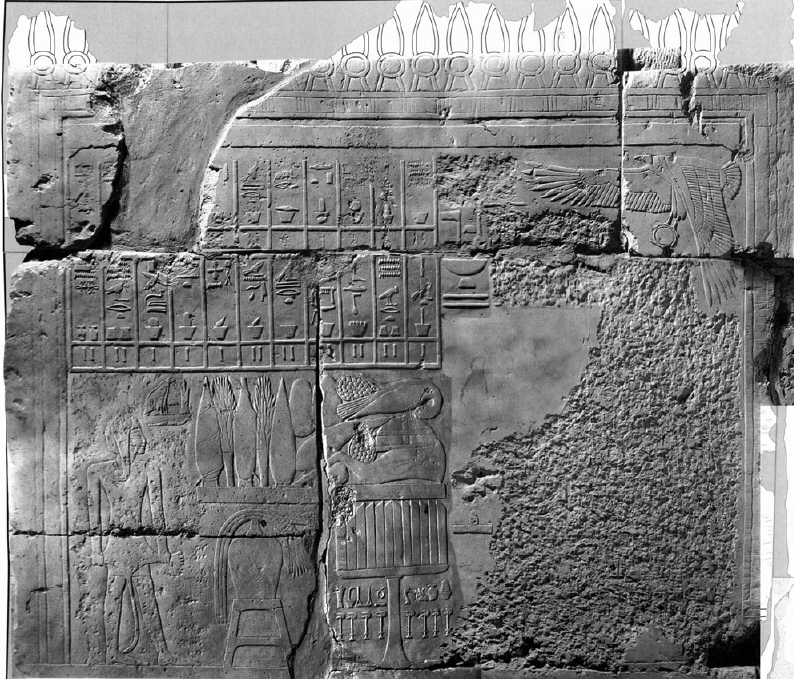
| Part of the decoration of the left (eastern) sidewall of the
southern niche of the altar court (taken from: Karkowski, J., DeB IV
The-Temple-of-Hatshepsut-The-Solar-Complex, Warsaw 2003; plate 45 bis). On the
left the Iunmutef is shown performing rites (which has been destroyed during the
Amarna period), in the middle the table with offerings and above the offering
list, on the right the destroyed figure of Hatshepsut. |
| The rear walls of the niches depicted Hatshepsut before one god
or between two gods. |
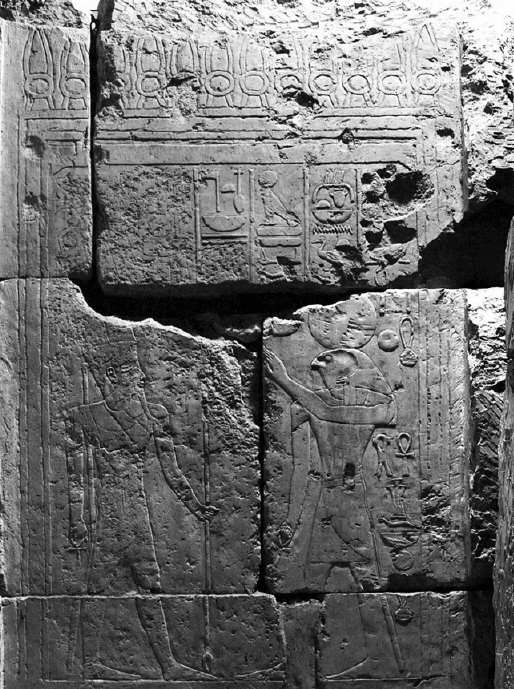
| Details of the decoration of the rear wall of the southern
niche (from: Karkowski, J., DeB IV
The-Temple-of-Hatshepsut-The-Solar-Complex, Warsaw 2003; plate 45 bis). The
scene showed Hatshepsut (destroyed) between Amun-Ra and Ra-Horakhty. |
| The niches had not been published
before, all the following information is based on Karkowski (2003). |
| The southern niche starts 164 cm above the pavement of the
altar court, the western niche 158.5 cm. |
| The inner jamb on the east side shows a much faded unfinished
ex-voto of Senenmut which corresponds closely to other figures of him left
behind doors in the temple. The sketch shows a 30 x 25 cm large figure of a
kneeling
Senenmut facing niche outwards, towards the altar. |
| The east wall of the niche shows a figure of Hatshepsut (78x105
cm, 54 cm above the pavement of the niche) sitting in front of a table with
offerings. Opposite to queen a Iunmutef-priest is depicted performing the rites.
The figure of the queen, her throne, the pedestal of the throne, and the
accompanying inscriptions had been largely destroyed. The Iunmutef-priest was
also destroyed but restored already in antiquity. |
| The southern (rear) wall showed (the destroyed figure of) Hatshepsut
(79.5x105 cm, 56.5 above the pavement of the niche), presented to Amun-Ra by Re-Horakhty
who also protected her. |
| The western wall shows a nearly identical scene (77.5x10⁷
cm, 53.5 cm above the pavement of the niche) like the eastern wall, again the
scene has been partly destroyed. |
| The western niche shows on its southern wall again an
enthroned Hatshepsut (75x114.5 cm) in front of a table with offerings. Opposite
to her the Iunmutef-priest is depicted performing the rites. The figure of the
queen is completely destroyed, her throne has survived. The figure of the
Iunmutef-priest was destroyed and restored in antiquity. |
| The west (rear) wall showed (a destroyed figure of)
Hatshepsut (77.5x55 cm) who was presented to Amun-Ra by Ra-Horakhty who is also
protecting her. The scene mirrors the scene on the rear wall of the southern
niche. |
| The scene (78x110 cm) on the northern wall shows with minor
differences to comparable scenes again an enthroned Hatshepsut in front of an
table full of offerings. Opposite to the queen the Iunmutef-priest is depicted
performing the rites. The figure of the Iunmutef-priest has been damaged during
the Amarna period.
|
| During the excavations a few blocks from the northern niche
which had been dismantled before the erection of the "Upper Chapel of Anubis"
were recovered. The preserved parts of the decoration show that the niche had
been decoration like the other niches. Remains of the side walls showed an
Iunmutef-priests before a table with offerings, remains of the rear wall showed
a king embraced by a god. |
| Night-Sun Chapel (Vestibule)
|
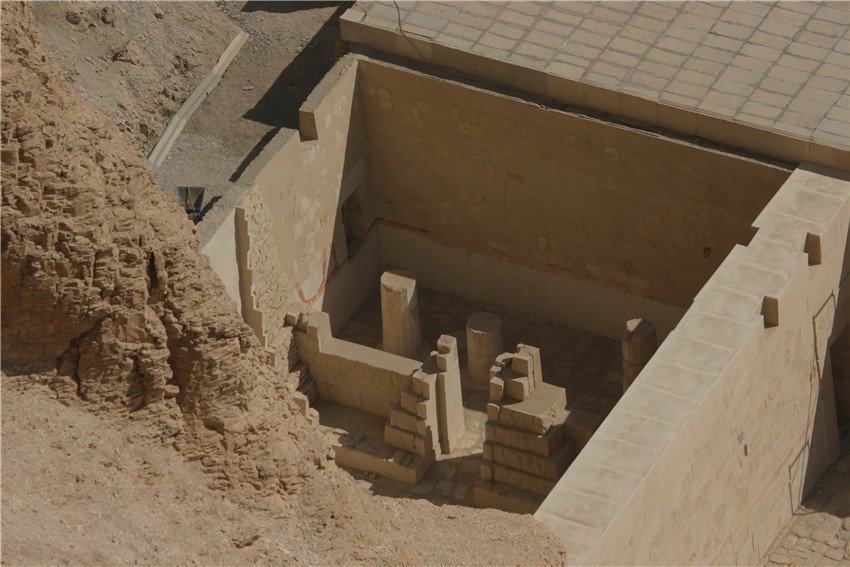
| View of the Night-Sun Chapel from the edge of the rock above. Left the northern wall with the niche, left of it the preserved legs of Amun and the queen.
The vestibule is separated from the sun-altar by a slanting wall. Since spring 2015 the sun court is accessible to visitors.
|
The
view
from
the
edge of the
rock
on
the
temple
shows
the
Night-Sun Chapel (vestibule)
with
the remains
of
three
pillars. It also shows
the
preserved
remains of the
passage
to
the
Sun Court.
The
walls of
the
Chapel,
the
niche
and
the
soffits
of the
main entrance
were
decorated
throughout,
but
not
all
scenes
are
so
well
preserved
that a
reconstruction is
possible.
|
The
reconstruction of
the
"Night-Sun Chapel"
revealed
that
the
chapel had a ceiling
and
was separated from the
Sun Court
by
a double-sided,
sloped
wall. Moreover,
this
wall contained
two
more
niches, one
each
on the
sides
of the
gate
to
the
Sun Court,
which were,
like
the
others
in
the
yard,
only
accessible
from
the court.
|
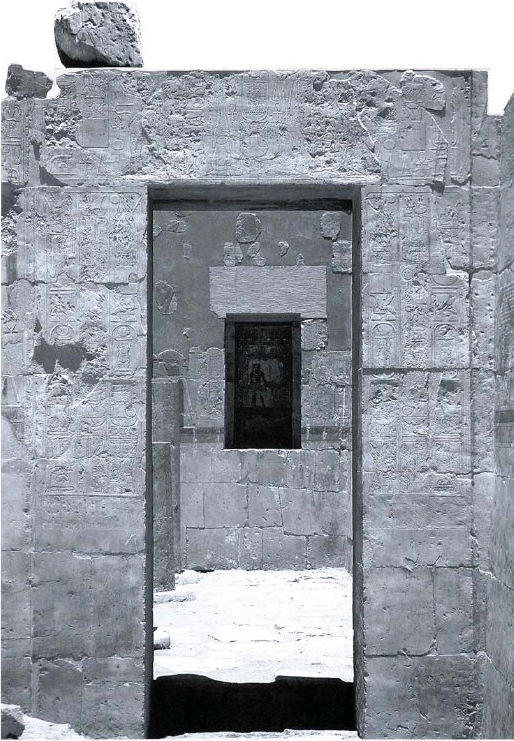
Gate
from
the
upper
terrace
to
the Night-Sun Chapel
(photo
tkane
from
Karkowski,
j.,
Deir el-Bahari
IV.
the Temple-of-Hatshepsut-the-solar-complex,
Warsaw
2003,
table 18). The
background shows
the
niche
in
the
eastern
half of
the northern
wall.
|
The southern
door jambs
show
on both sides the
titles of
Hatshepsut
(amended to
Thutmosis
II).
The architrave
shows symmetrically to
a %mA-tAwy-scene
the god Amun presenting life to
Hatshepsut
and
Thutmosis
III.
Below
the
vertical
registers
with
the
titles
the
remnants of
two
door names are visible.
Karkowski
reconstructed
the
names
to:
"sbA Mn-xpr-Ra Jmn +sr Axt
=
Doorway
of
Men-kheper-Ra,
Holy
in
the
horizon
of
Amun"
(on
the
left,
West side)
and -
"sbA MAat-kA-Ra Jmn +sr.t Axt
= Doorway
of
Maat-ka-Ra, Holy
in
the
horizon
of
Amun"
(on
the
right,
eastern side of the
door).
|
The
western reveal
of the
door
shows
a
single
scene
that
follows
the
trapezoidal shape
of
the
wall:
Hatshepsut
(amended to
Thutmosis
II)
enters the Night-Sun Chapel,
dressed
with
the
shendjyt,
a wesekh-collar,
and
the Double
Crown.
She is striding to
Amun
who
gives
her
life.
The
falcon-headed
Ra-Horakhty is shown behind the queen touching her shoulder
protectively with one hand on
and
fixing
the Double
Crown
on
her
head
with
the
other.
|
The
eastern reveal
once showed in sunken relief
a kneeling Senenmut
praying
with raised
hands
and
looking
into the
chapel.
Figure and text were
carefully chiselled
out.
The soffit
of the
doorway was decorated
with
yellow
stars
on a
blue
background.
|
On its southern
(inside)
side
the
lintel of the doorway
carries
three
horizontally arranged
registers. The upper register was decorated with a
winged
solar disk
with
two pendent
uraei.
The two registers below show
symmetrically
arranged
to
an
anx sign the
throne name
"Maat-ka-Ra,
loved
by
Amun-Ra" (middle register) and the
birth name
"Hatshepsut,
loved
by
Amun-Ra".
In both
lines
the cartouches
had been amended
to
Thutmosis
II.
and
the
"beloved
of
Amun-Ra" had been
replaced by
"Amun-Ra, king
of
gods".
|
The
door jambs
on both sides carry
in
two
vertical
registers
the queen's
throne
and her birth
name
(amended
to
Thutmosis
II).
|
Above
the
architrave interior
was
decorated
the
with
a
scene,
the
originally
showed Hatshepsut
and
behind
her Thutmosis
III
- both
kneeling -
how
they offered
wine
to
an
enthroned
deity.
The figure
of
Hatshepsut
was erased
and
replaced
by
a
pile
of
offerings.
The
representation
of the
deity
is destroyed and
no the deity
longer
identifiable.
|
Right
(West)
of
the
doorway
some
stone blocks
have survived with
remains of
a
representation
of
Thutmosis
II
remain who
honored
the
ithyphallic
Amun.
Originally
showed
the
scene showed
Hatshepsut
embracing
the
ithyphallic
Amun
but
was reworked.
|
The
East wall
was
decorated
with
at least
two
scenes showing
Hatshepsut
serving
as a
priestess
of the
Sun God.
The
decoration
refers to
the
night journey
of the
Sun,
from
the
first
hour
of the
night
after
sunset
in
the
West
up
to
the
dawn
and
sunrise
in the East.
|
The
North wall
shows
on its
western
(left)
side
remains of
a
representation
of the
queen before
Amun,
however,
only
of their
legs
(see
photo
above) have been preserved.
In
the
eastern
side
of the
North wall there
is
a
niche
(described
below).
|
Only a few
scattered
stone blocks of
the
west wall have
survived.
From
the
few
details shown on
these
blocks,
Karkowski
(loc.
cit.)
reconstructed
- probably -
identical scenes
right
and
left
of the
door passage
to
the Sun Court:
each left
and
right
side
of the
doorway
the
queen
was probably shown
embracing
Amun.
In
each scene,
probably
the
Ibis-headed
Thoth
was depicted behind
the queen
and
recording her
countless
years.
|
The
preserved
blocks of
the
door jamb show the
titles
of the
queen
(amended
to
Thutmosis
II).
Above
the
architrave of
the
door
(of which no blocks have been found) Karkowski
reconstructed
a
solar barque.
However, up to now just
one
block of
this
scene
has
been
found
.
|
| Niche of the Night-Sun Chapel |
| The eastern part of the north wall of the Night-Sun Chapel
contains a niche
(opening 152x82 cm) about 138 cm above the pavement (lower border).
|
| The jambs of the niche showed in two identical symmetrical
texts in two registers the titles of Hatshepsut. The inscriptions were almost
completely erased later but divine names restored. |
The
western reveal once
showed a
representation
of an
adoring Senenmut which
is known from other temple areas.
The
111
x
33
cm
tall
figure
of the
kneeling
Senenmut faced left
looking
into
the
Night-Sun Chapel.
The figure in sunken relief was chiselled out. The
accompanying inscription
located above his head
is
completely
illegible.
|
| The eastern reveal carried a mirror-image. The kneeling
Senenmut was facing right, out of the niche. The 110x26 cm tall figure of
Senenmut and the text
above his head were completely chiselled out. |
The
decoration repeats
the
scheme
of
decoration
of the
niches
of the
Sun Court,
i.e.,
on
the
side walls
were decorated with an
enthroned
Hatshepsut sitting
before
a
table of offerings,
opposite
to her a
Iunmutef priest
is performing
the rites.
|
The
North wall
(back wall)
showed
Hatshepsut
(completely
destroyed) who was
probably
embraced
by
Amun.
In
the
aftermath of
Amarna,
the
figure
of
Amun
has been
restored,
whereby
the scene
was
changed,
because
the
figure
of
Hatshepsut
was
not
restored
|
|